coffee

img_1841

It’s time to return to an earlier post.  A KM colleague and friend gently steered me towards this excellent Radio 4 and World Service broadcast.  In 1687, in Tower Street, London a coffee shop opened.  Here the patrons could enjoy ‘fires, tea, coffee and sherbet’…and gossip.  And, boy, did these patrons like to talk about ships and their comings and goings: the tides, the ports, the captains, the cargoes.  Eventually, the proprietor, Edward Lloyd, started a newsletter – Lloyd’s List – to capture the knowledge circulating within Lloyds’s Coffee House and so an industry was born.

You could argue that Lloyd’s List was a classic example of how to take unstructured knowledge – the swirl of conversation that embraced facts, rumour, speculation and intuition – and make it explicit via a physical artefact.  But did those conversations then shrivel and wither in the face of this written competition?  I would wager (which was an integral activity within the 17th century coffee house) they intensified as the List was discussed, dissected and deconstructed.  I would also wager that stories were a vibrant thread through those conversations.  And those stories were rich with meaning  impossible to capture  in a simple journal.  It wasn’t just the words; it was also the performance: the gestures, the intonations, maybe the ushering into a quiet booth before the story was told, that would have helped convey the experience.  As Walter Benjamin, argued, experience is the “source from which all storytellers have drawn”.

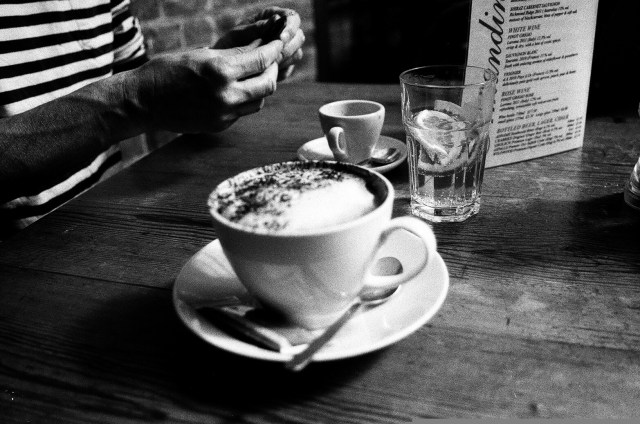
There is something else about Lloyd’s Coffee House which interests me.  It was a space that combined the social (the partaking of tea, coffee and sherbet) with business.  This ambiguous space was re-visited by that most incisive of KM commentators, Chris Collison, in his mischievous post about the KM powers of coffee. He gives eight reasons for why coffee is KM’s most effective tool.  I would add a ninth.  It unlocks stories.  Just as the patrons of Lloyd’s Coffee House found the environment and the caffeine a stimulus to stories, so I have noticed something similar in our 21st century cafés.

Rather than take clients to a formal meeting room, I prefer to take them to our work café.  It immediately injects a curious dynamic to our conversation.  We are moved out of the purely business and formal to a more ambiguous environment.  And here the conversation becomes looser.  The influence of the social context encourages revelation and confidences.  Although, anecdotal, I also hear more stories as we sip our espressos, macchiatos or green teas, than I wager I would in the polished wood and hard-backed chairs of our ‘proper’ meeting spaces.  And that way, knowledge is conveyed.  Rich knowledge not just about the topic under discussion but about the personality, the motivations, the values, the beliefs, the fears, the frustrations, the ambitions of my fellow imbiber.

As Dr Feelgood, purveyor of so many truths once wisely observed, “Java Blue, when the coffee’s got me”.

Insurance

A good friend and colleague reminded me earlier in the week about a blog I had written nearly nine years ago about Lloyd’s of London.  You may know the building: a Richard Rogers masterpiece which really does look like nothing else in the city and which famously displays its insides on the outside, so to speak. At the time, I had been struck how a strikingly modern exterior conceals a world that is profoundly Dickensian. The Lutine bell guarded by an assistant in his Victorian red jacket and top hat; a cabinet of Nelson memorabilia; a huge log recording ship losses in perfect ink calligraphy. And, around this museum-like core, a series of huge trading floors full of underwriters’ booths where brokers queued to place their risks face to face (or rather eyeball to nose as brokers sat two inches below underwriters to ensure the underwriters’ eye level was above that of the broker). I saw people carrying unfeasibly large bundles of paper (indeed, the more astute wheeled suitcases of the stuff) and risks were recorded not on a laptop or tablet but written on a chit of paper.

I had not realised it then, but this was a peculiarly liminal world.  An unsettling locale where the starkly modern mixed with the quaintly traditional.  And, so, surely a place of stories as well as transactions?  For here, what lay at the heart of business, was a reliance on face to face contact as the primary way of doing business. Some commentators have used the analogy of the bazaar to illuminate the workings of knowledge management and it was not a huge leap of the imagination to see the Lloyds trading floor as a more starchy, peculiarly British version of a Moroccan souk. Business was transacted via, and underpinned by, the knowledge and trust that evolves via a network of direct relationships enclosed in a defined physical space. It was a true market.

At the time, it was an exciting reminder that  KM  can be a messy, chaotic thing that happens when you put people together in one place and they talk, and they get to know each other and the knowledge they learn in the process is filtered by and developed in the context of what they feel about that person and the extent to which they trust them. Think of the way lawyers are trained: a trainee lawyer, like a medieval apprentice, “sits” with a principal which means they don’t just learn technical legal knowledge but a whole raft of other essential expertise from negotiation and client management to delegation and business development. And a fair amount may occur through pure osmosis rather than conscious tuition: the physical proximity of sharing an office together.  It may also involve stories – the unconscious recounting of examples, analogous situations – some mundane, some heroic, some minatory.

So maybe the lesson is for us to maximise opportunities for face-to-face contact, to facilitate the “osmotic moment”; but not in a mechanical prescribed way but by making it a natural part of working together and doing business.  And who knows what stories may emerge.

And, talking of stories, Lloyd’s, of course, started over 300 years ago as a coffee shop.  So maybe my next post will be about coffee; maybe…

Reception

I spend many hours in corporate receptions.  But it is never time wasted.  These are the liminal shorelines between the world outside and the inner workings of the organisational machine.  A patrolled borderland; a crossing that requires proof of identity and the scrutiny of papers.  Only when legitimacy has been established can the journey continue.  At a personal level, these are places of transition.  Moments before I may have been thinking about other things – a tv programme, a weekend run – but when I turn through the revolving doors, my identity elides.  I focus on the coming meeting and the conversations that may take place.  But even this work persona is compromised.  Here, I am a stranger; an outsider – the supplicant at the gate craving entry.  My security card is, in this country, worthless tender.

So perhaps this unease, this uncertainty make me more receptive to what I see.  And what I – or anyone can see – if they take care to look carefully enough, is a window – opaque and perhaps grimy – but a window none the less into the organisational soul.  Often there is marble, light, atria – hard, composite surfaces blending with soft leather furnishings.  They suggest a promise of what the organisation is and how it would like to be seen.  Every item – from the artful vase of flowers by the receptionist to the lithographs on the wall – projects a story.  Sometimes the story is literal.  Displays that hint – or sometimes shout – at the organisation’s history: its founding myth, its beginning, middle but, of course, never its end.  There may be corporate books or magazines on  the hardwood tables.  These in turn may include stories that convey the values, the ethos, the everyday culture: a day in the life of our logistics manager in Redditch; a client’s tale of exemplary service.  Stories that sustain and support identity and brand.

Of course, you must also look for what is not there.  What might you expect that is not on public view?  The organisation’s madwoman in the attic – the story that is suppressed and fettered.

Finally, look at the dramas that play before you as you flick through the corporate magazine, maybe a small coffee to hand, all the time glancing at your watch as you await the emissary who will convey you across the border.  How do these embody or subvert the knowledge and intelligence you have gained through the more explicit stories around you? As employees pass through, do they smile, talk, joke – acting out the value of ‘collegiate’ so proudly displayed by the lifts?  Is the strident value of ‘respectful’ demonstrated by a friendly ‘hello’ to the security staff and receptionist; or is there a purposeful aversion of eyes that tell a different tale, a more truthful tale?

And each time you wait, the stories build.  A palimpsest of impressions, insights and intuitions that help you navigate the uncertainty and unease of your fragile, visitor’s status.