There is a throng outside the lift. Or, maybe, we wish to avoid the taint of guilt that comes with ascending or descending so effortlessly, so painlessly. Decisive, emboldened, we make the decision: “let’s take the stairs”. Perhaps though, what attracts us is a suppressed taste for the marginal, the overlooked, the liminal. For, make no mistake, as we push open the doors clearly marked ‘Stairs’ or, more opaquely, ‘Fire Escape’, liminality has claimed us.
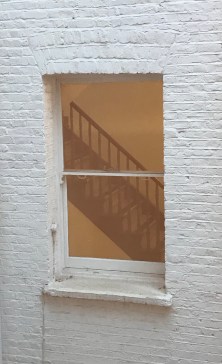 Stepping between floors, we are, spatially, betwixt and between: poised between one zone of experience and another. Or, as AA Milne (and, yes, the Muppets) phrased it: ‘It isn’t really anywhere! It’s somewhere else instead!’ In a recent Radio 4 Thought for the Day broadcast, Rabbi Dr Naftali Brawer describes the painting by the Baroque artist Jusepe de Ribera called Jacob’s Dream. The sleeping Jacob dreams of a ladder that climbs to heavens with angels ascending and descending. Brawer draws attention to how Ribera depicts Jacob’s face: it ‘exquisitely captures the betwixt and between of liminality, reflecting Jacob’s suspension between two realities; the terrestrial and the celestial.’
And where there is liminality, there is possibility, opportunity. A few years ago, a friend showed me the open plan office where he worked. “What do you see?” he asked. “Well, nothing”, I replied: there was no conversation, no energy. People worked, heads down, fearful of disturbing their colleagues. My friend and I agreed how ironic it was, that a space designed for collaboration engendered its very opposite. Or, to recast it in a Lefebvrian light: conceived space was demonstrably at odds with lived space (Dale and Burrell, pp.8-10). “So, I asked, where do the conversations, the stories occur?”. With a grin, he took me by the arm, led me around the corner and through a door. “Here,” he replied, pointing to the utilitarian, white walled, concrete stairwell that rose before us.
For my friend, the stairs represented a space for random exchange or, as the short broadcast by Monocle (The Beauty of Stairs) notes, a ‘stage for incidental conversations’. And where there are conversations, there are always stories. Curiously, the metaphor of the stage is also identified by Patrick McGuinness in his recollection of childhood – Other People’s Countries. He observes of a couple’s arguments that they were ‘always held, like dialogue in Racine, in transitional spaces – hallways and corridors and staircases’. [and thank you Mark Gould for the reference].
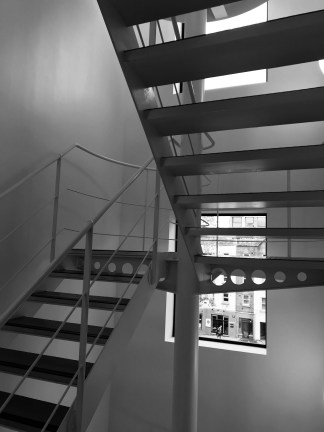 The staircase serves as a vertical corridor – a space for serendipitous encounter and exchange. Such happenstance can, of course, be gamed. Gieryn indicates how innovation in high-tech companies was enhanced by the artful design of micro-geographies that provoked the unexpected. For example, by installing a single stairwell, ‘open and inviting enough to encourage lingering talk’ (Gieryn, p.477). Such a stairwell may not possess physical centrality yet it is functionally central (Fayard and Weeks, p.615). It also, I suspect, embodies Kornberger and Clegg’s ‘architecture of complexity’ where ‘space has to contain possibilities, which might be perceived as emptiness’. Such ‘generative buildings’ create ‘margins where things are loosely coupled’: for example, stairs ‘which invite us to stop and pause for a minute’ (Kornberger and Clegg, p.1106). Underpinning this is the opportunity for movement. As Markus (quoted in Dale and Burrell, p.282) notes:
The traditional means for movement were cloisters, corridors and staircases – static spatial systems through which people and objects moved. Lifts and hoists reversed this; there was now a dynamic system where a piece of moving space contained static people or objects.
Yet our movement up and down stairs is perhaps more conscious than that along cloister or corridor. The perils of a fall or stumble are always present. Edensor discusses sensual engagement with ruined spaces and, just as he is aware of the ‘well-worn smoothness of a wooden stairway’s handrail’ (Edensor, p.119), we too are alert to the secure feel of a step underfoot. And maybe this heightened consciousness where touch and sight elide is another sign of the liminal. With flux comes perception.
But stairs have other uses in our organisations. In her superb study, Harriet Shortt explores how hairdressers make meaning out of the liminal spaces that surround them. Stairs become places for privacy and refuge: intimate ‘dwelling places’. Away from the public spaces of the salon or staffroom, the margins can be reclaimed, recolonised. Once, when descending to a damp and fungal basement, I found a colleague contentedly sitting on a cold step: sandwich, cheese and onion crisps and tabloid by his side. Like Shortt’s hairdressers, he had reconfigured this desolate pace to create ‘a sense of belonging and attachment and meaning’ (Shortt, p.654).
Yet liminality, as Brawer indicates, is also ‘ambiguous and disorientating’. With each twist of the staircase, the view below and above is obscured. Who knows who – or what may be coming? For T.S. Eliot, the first turning of the second stair reveals the ‘same shape twisted on the banister/Under the vapour in the fetid air’ while the first turning of the third stair brings the ‘hawthorn blossom’ and the ‘broadbacked figure dress in blue and green (Eliot, p.87). It may stimulate congregation and creativity but the staircase is also haunted by Nosferatu’s shadow.
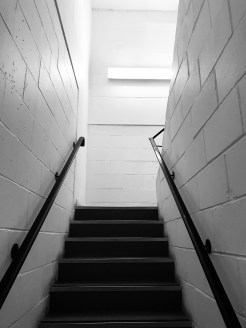 In a perceptive analysis of white spaces, Connelan notes the visceral reaction of one interviewee to the staircase in an art school: it ‘gives me the creeps, it reminds me of [the detention centre the person was incarcerated in] (Connelan, p.1543). There is a ‘brutality inscribed into the identity-less space’. The blank institutional whiteness of steps and stairs create a stark backdrop against which it is easy to be seen. You are isolated, silhouetted, the object of the carceral gaze. Here, white materialises power and exerts control. This creates not Foucault’s mobile panopticon but a ‘ubiquitous panopticon’ in which ‘watchfulness is everywhere and nowhere’ (Connelan, p.1545). The staircase encourages us both to linger and to escape.
So next time, you visit a new building, resist the lure of lift and elevator. Instead seek out the liminality of the stairs. They may bring possibility, comfort, enlightenment. For, as the song – which always remains the same – reminds us, the stairway leads to heaven. Yet never forget, stairs go both up and down: so, beware, your destination may – equally – be warmer than anticipated.
Brexit: the power and danger of liminality (2017) BBC Radio 4, 24 October. Available at http://www.bbc.co.uk/programmes/p05kszgw.
Connellan, K. (2013) ‘The Psychic Life of White: Power and Space’, Organization Studies, 34(10), pp. 1529–1549.
Dale, K. and Burrell, G. (2008), The Spaces of Organisation & the Organisation of Space: Palgrave Macmillan.
Edensor, T. (2005), Industrial Ruins: Spaces, Aesthetics and Materiality: Berg.
Eliot, T.S. (1954) ‘Ash-Wednesday’, in Selected Poems: Faber, pp. 81-93.
Fayard, A.-L. and Weeks, J. (2007) ‘Photocopiers and Water-coolers: The Affordances of Informal Interaction’, Organization Studies, 28(5), pp. 605–634.
Gieryn, Thomas F. (2000) ‘A Space for Place in Sociology’, Annual Review of Sociology, 26, pp. 463-496.
Kornberger, M. and Clegg, S. R. (2004) ‘Bringing Space Back in: Organizing the Generative Building’, Organization Studies, 25(7), pp. 1095–1114.
McGuinness, P. (2015), Other People’s Countries: A Journey into Memory: Vintage.
Shortt, H. (2015) ‘Liminality, space and the importance of “transitory dwelling places”, Human Relations, 68(684), pp. 633–658.
The beauty of stairs (2017) Monocle, 16 June. Available at https://monocle.com/film/design/the-beauty-of-stairs/.
Illustrations
Rodwell, I. (2017) Stair 1, Stair 2, Stair 3
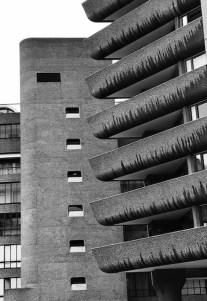 The Barbican in London is a source of solace. Walking the grey, water-stained ramparts, I feel protected by its coarse solidity. The hard, excoriating drag of bush-hammered aggregate reassures rather than pains. This is a place – fittingly given its name – of defence, retreat and enclosure. In my more oneiric moments, I imagine a dystopian city of hand to hand fighting – a Stalingrad for a future age – with the Barbican providing the last refuge for defiance and resistance. With a morbid eye, I see the walkways and towers pitted by shellfire revealing the twisted steel rods within.
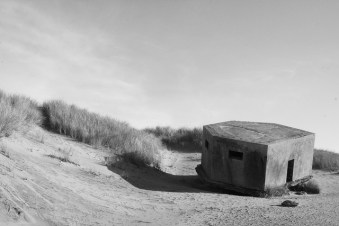 Several of these
 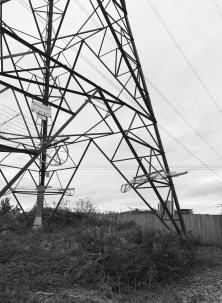 These edge lands – where ‘urban and rural negotiate their borders’ (Farley and Roberts, loc 183) – seem no more than ‘repositories for functions we prefer not to think about’ (Shoard, p.75). Gasometers, electricity sub-stations, security lit business parks, car pounds, sewage works, pylons, razor-tipped fencing and marshalling yards. They circle our towns and cities: uneasy crossing places haunted by ‘the neglected, the disposed of, and the repressed’ (Edensor, p.833). But, if we look carefully and without prejudice, we can recast these ‘unobserved parts of our share landscape as places of possibility, mystery, beauty’ (Farley and Roberts loc 198).
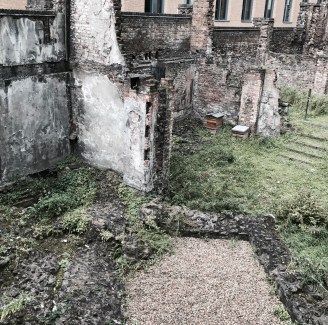 For look beyond the abandoned pallets and rusty JCBs, and vitality, energy and creativity emerge. What more could we expect in the marginal and liminal? Marion Shoard argues how edgelands are rich in plant and wildlife diversity: protected, forgotten and free of monoculture, pesticides and our compulsion to trim and prune. Similarly, Richard Mabey tells how rosebay willow herb and other ‘weed tenantry – ‘green and golden fennel and ragwort, coltsfoot, purple loosestrife’ – proliferated in the bombed out City warehouses and offices of the Blitz (Mabey, p.216). Glimpses of these ruderal fireweeds can still be found. By the
 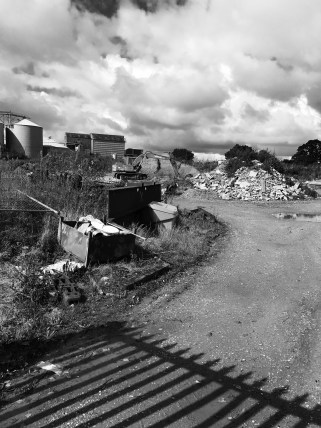 Even in one building though, we can locate edgelands. Think of lifts, basements, the maintenance workshop or, indeed, the humble photocopier room. Utilitarian in design and decor, it seldom provides a home to the artwork that decorates other walls or offers panoramic views of tower and sky. But, as wasteland attracts the detritus we casually discard there – fridges, tyres, thieved and ransacked slot machines – so here we find the box of Christmas decorations and a rag-tag of superseded office equipment. And, as we know from apocryphal tales of office parties, these humble backwaters generate their own transgressive stories.
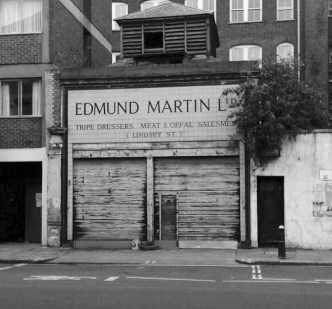 But these suggestive, liminal ruins are betwixt and between in other ways. Their journey of transition is constant as agents such as wind, rain, lichen, moss, birds and insects recast their identities and ‘transform the qualities of matter’ (DeSilvey and Edensor, p.477). This is not necessarily a cruel or pitiless destruction. Looking into a marble fountain,there is ‘intimacy in the contact’ between stone and water that ‘here produces a gleaming surface veined with unsuspected colours, here magnifies fossil or granular structure’ (Stokes, p.26). Ruination can be gentle, caressive, revelatory.
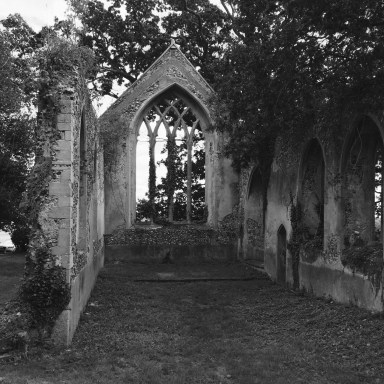 For this is a place where the visual is less privileged and where, unlike the usual tourist spaces, ‘the tactile, auditory and aromatic qualities of materiality’ are enhanced (Edensor, 2007, p.219). We are keen to the sound of the strimmer in the overgrown churchyard; the smell of the cut grass in the porch; the feel of the twig that bends underfoot as we navigate around fallen gravestones. This is Lefebvre’s perceived space – the ‘phenomenologically experienced spaces, that may be taken for granted through the habits of the body’ (Dale and Burrell, p.8). Note how we stoop past the shrub overhanging the south door – an automatic, reflex action.
 Liminal Narratives