They are there. And you have seen them. Perhaps from a train as it lurches and jolts over the points and junctions outside a city terminus. A glance through the window and they emerge into view. Or, perhaps, on a busy street, you raise your eyes from pavement and shopfront to glimpse what you have never noticed before. Faded, translucent; pallid imprints on brick and stone. Maybe an advert, no longer shouting but whispering about a long-forgotten brand – clothing, cigarettes, flour, razors. Or a sign that tells of former use and occupancy: grocer, hostel, furrier. These are ‘vestiges of spaces and places, industries and individuals’ that tell stories of ‘history, identity, cultural memory, desire, nostalgia, and erasure’ (Shep, p.209).
The city, however, does not tell its past, but contains it like the lines of a hand, written in the corners of the streets, the gratings of the windows, the banisters of the steps (Italo Calvino, quoted in Shep, p.210)
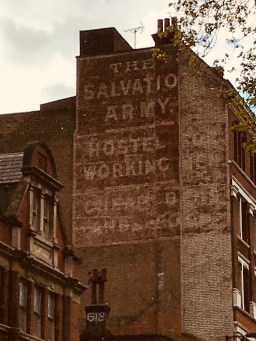 These signs – material and metaphoric – ‘both reveal and hide their identity’ (Shep, p.209). They exist in plain view yet their meaning has to be negotiated via erosion, neglect and decay. Like Baudelaire’s flaneur detective, we need to decipher and deduce (Benjamin, p.37). For these signs exist at the liminal convergence of topography, typography and temporality (Shep, p.210). They inhabit multiple margins; permeate many thresholds. And this very materiality is, of course, liminal. As scouring wind, rain and pollution ‘transform the qualities of matter’ (DeSilvey and Edensor, p.477), their journey of transition is constant: as ‘palimpsests, they register change over time’ (Shep, p.209).
These signs are also ghosts. And ghosts, we know, are spectres of the liminal. They are the ‘non-object, this non-present present, this being-there of an absent or departed one’ (Derrida, quoted in Orr, p.1055). They show us ‘that which appeared to be not there’ (Edensor, p.159). A brand of beer last drunk in the 1950s; a business whose final invoice predated the dot-matrix printer.
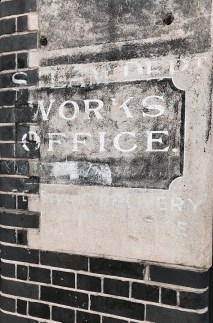 And there is something both poignant and heroic about these ghost signs. Even though their purpose – their signified is absent – they continue to signify to an intended audience that, in all probability, are ghosts now too. It brings to mind an abandoned turntable endlessly playing the same track to a long-departed listener. For these ‘names and slogans…were not meant for our contemporary eyes’ (Roberts and Marshall, p.3). And this, maybe, is what captures our gaze from train and street. This prickling of curiosity; a glimpse of something we can’t immediately comprehend yet sense, in some way, to be important. The sudden sound of static that interrupts our car radio on a moonless country road: significant but unknowable.
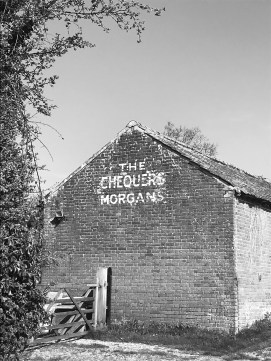 Such ghosts ‘haunt the present in such a way as to suddenly animate the past’ (Edensor, p.159). As I walk up the lane towards the sign of the former Chequers pub, I am conscious that my steps echo those of villagers who, for many years, would have tramped the same route after a day working the fields. And their embodied practices and daily rituals are now re-enacted by those now drawn by the sign. The past is reinvented and reimagined with each step. As Edensor notes, we ‘perform the past by putting our bodies into its flow’ and, in so doing, ‘it ceases to be pure memory; it is lived in the present’ (Edensor, pp. 150-151). And these experiences, these micro-narratives we co-create through such embodied empathy, although fragmentary and seemingly incoherent, ‘offer opportunities for constructing alternative versions of the past, and for recouping untold and marginalized stories’ (DeSilvey and Edensor, p.471). The ‘enigmatic traces’ of the Chequers pub invites me to ‘fill in the blanks’ (Edensor, p.162). My imagination – via stories – aims to ‘impose a formal coherence on what is otherwise a flowing soup’ (Weick, p.128).
And confronted by ghost signs, maybe we too become liminal. In Stefan Schutt’s account of ghost sign hunting through the streets of Adelaide, he speaks of an ‘initial sense of estrangement and disconnection’ (Schutt, p.55). It as if, gently shifted from our usual, habitual way of perceiving the world we become more attentive to those ‘talking walls’ (Shep, p.209). And, in becoming attuned to these new frequencies, this unfamiliar language, we are, momentarily, disorientated. Our senses are truly betwixt and between. Schutt reflects that in searching for old signs, ‘elements of serendipity and arbitrariness break down invisible barriers formed by habits of use, letting the walker see their environment in new ways’ (Schutt, p.54). This quest on foot is also a ‘space of enunciation’ that ‘affirms, suspects, tries out, transgresses, respects, etc., the trajectories it ‘speaks”(de Certeau, p.99). Here we find estrangement, enlightenment and transgression: the liminal experiences that our search for ghost signs engenders.
As a final reflection, we should not forget that in reanimating the past, urban ephemera also serve ‘to illuminate and transform the present’ (Massey, quoted in Schutt, p.57). For these signs gift us a warning. We are complacent in our organisations – comforted by the demand for products we make and services we offer – yet, if we glance in the shadows, the memento mori gather. Edensor identifies the mirthless irony of ghost signs faded to indecipherability – a bitter way to mock ‘the energy expended on fixed meaning through branding and advertising’ (Edensor, p.162). Like the ochre and yellow wall paintings of the three living and the three dead uncovered from the peeling plaster of a medieval church, our ghost signs have an admonitory message: such as I was you are, and such as I am you will be. Organisations and institutions rise and fall. Products and brands come and go. Are we any different?
But maybe dissolution is not inevitable. Yesterday, I went searching for a particular ghost sign in Clerkenwell. However, this sign advertising the now vanished Black Cat Cigarettes brand has, itself, vanished. Completely hidden by a new residential block which has erased it from view. But perhaps not erased from existence. Although hidden, it merely sleeps: suspended between past, present and future; revelation and enclosure; communication and silence. And, as fashions change, perhaps the new apartments that conceal it will, in their turn, succumb to the demolition notice. Then, as the wrecking ball strikes, the Black Cat – a typographical Sleeping Beauty – will wake again. And just as some deceased brands – like East Anglian beers, Lacons and Bullards (but alas not Morgans) – have risen like Lazarus from their corporate graves, so others may emerge blinking in the light. For, in the final reckoning, our signs are indeed ghosts; but ghosts who speak not only of decay and negation but of resurrection too.
Benjamin, W. (1983). Charles Baudelaire: a lyric poet in the era of high capitalism.Verso
De Certeau, M. (1984), The practice of everyday life: University of California Press.
DeSilvey, C. and Edensor, T. (2013) ‘Reckoning with ruins’, Progress in Human Geography, 37(4), pp. 465–485.
Edensor, T. (2005). Industrial ruins: spaces, aesthetics and materiality. Berg.
Orr, K. (2014) ‘Local government chief executives’ everyday hauntings : towards a theory of organizational ghosts’, Organization Studies, 35(7), pp. 1041–1061.
Roberts, S. and Marshall, G. (2017) ‘What is a ghost sign?’, in Schutt, S., Roberts, S. and White, L. (eds.) Advertising and public memory: social, cultural and historical perspectives on ghost signs. Routledge.
Roberts, S. and Groes, S. (2007) ‘Ghost signs: London’s fading spectacle of history’, Literary London: Interdisciplinary Studies in the Representation of London, 5(2). Available at http://www.literarylondon.org/london-journal/september2007/robertsgroes.html (Accessed: 27 April, 2018)
Schutt, S. (2017) ‘Rewriting the book of the city: on old signs, new technologies, and reinventing Adelaide’, Urban Geography, 38(1), pp. 47–65.
Shep, S. J. (2015) ‘Urban palimpsests and contending signs’, Social Semiotics, 25(2), pp. 209–216.
Weick, K.E. (1995). Sense making in organisations. Sage.
Illustrations
Rodwell, I. (2018) Clerkenwell, London
Rodwell, I. (2018) Spitalfields, London
Rodwell, I. (2018) A loke, Norfolk
 But then, this should not surprise us. For the crossroads is a place of contradictions. A liminal space caught between borders and possibilities. It is a ‘real place between imaginary places – points of departure and arrival’ (Komunyakaa, p.5). We stand poised between where we have been and where we might, in the future, find ourselves. This is the ‘intersection of the timeless moment’ (Eliot, p.42). Opportunity, danger, enchantment, despair, salvation and damnation insinuate themselves, like a twilight mist, around our lonely fingerpost.
 The ambiguity of the crossroads is also seen in the tradition of burying of suicides. Halliday notes that although the law in England stipulated that a suicide should be buried in the King’s highway, the chosen site was often a crossroad by a parish boundary (Halliday, p.82). I frequently pass one such site. In 1785, Richard Knobbs, a brickmaker in the Norfolk village of Hempnall, was suspected of murdering his son and hanged himself from a tree. The junction where he is buried is still known as Nobb’s Corner. Halliday argues that such interment acted as a deterrent. Excluded from the community of a churchyard, burial in a ‘remote, anonymous grave without a funeral was a casting-out; the person no longer belonged to society’ (Halliday p.82). Yet, maybe, such a place provided comfort too: the topographical cross bestowing some remnant of sanctity on the lost and, in every way, marginalised.
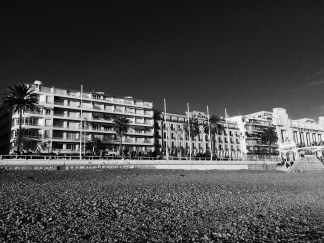 And, like all liminal spaces, the beach offers promises of transformation. In Rob Shields’ fascinating analysis of Brighton’s cultural positioning, he argues how the Prince Regent, later George IV, popularised the ‘reputedly restorative powers of sea-bathing’ (Shield, p.75). For the sick and valetudinarian, this was a pilgrimage covenanting physical renewal. And the reward for the devoted traveller was the ‘Cure’: a programme of prescribed sea-dippings (the rites of the liminal phase) officiated by ‘Dippers’. These ‘priests’ carefully (or forcefully) assisted their charges from the bathing machines: ‘mediaries between two worlds, civilised land and the undisciplined waves’ (Shields, p.84).
 Remember though – the beach of summer becomes the beach of winter. And this brings more caliginous meanings. The borderlands and margins are ‘also places of anxiety replete with darker images of threat and danger.’ (Preston-Whyte, p.350). These ‘placeless places’ of No Man’s Land and crossroads – where the gibbet stands and the graves of suicides and witches lie – invite the liminal’s shadow (see Trubshaw, 1996). In M.R. James’ A Warning to the Curious and Oh, Whistle, and I’ll come to you, My Lad, the landscape of the beach reflects a ‘temporal instability’ where an artefact from the past has the power to exact a dreadful vengeance in the present.
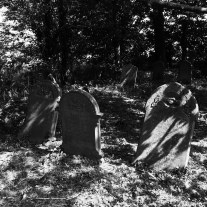 Strolling along the well-tended gravel paths or clambering over crumbling, bindweed ensnared masonry, we can easily slip between multiple worlds. In their considered and sensitive study of roadside memorials, Clark and Franzmann note how these sites challenge ideas about what is public/private or secular/sacred space: they blur the ‘somewhere that is nowhere in particular rather than a special place, and something that is passed by rather than permanently set aside as a place of pilgrimage’ (p.586). As we stroll or clamber, are we visitor, pilgrim, the transitory or the purposeful?
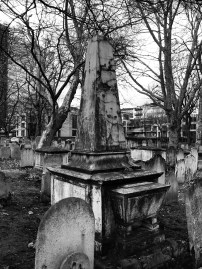 For Foucault, the cemetery is an example of a heterotopia: sites which ‘mirror and at the same time distort, unsettle or invert other spaces’ (Johnson, 2013, p.790-791). It is a place ‘unlike other cultural spaces’ (Foucault, p.4) yet which is connected with all sites as ‘each individual each family has relatives in the cemetery’. As Johnson notes, cemeteries incorporate many of the characteristics of heterotopias that Foucault identified. They are ‘privileged or sacred’ sites reserved for a critical rite of passage; they ‘contain multiple meanings; and they are both utterly mundane and extraordinary’ (Johnson, 2013, p.799). Intriguingly, they also begin ‘to function at full capacity when men arrive at a sort of absolute break with their traditional time’ (Foucault, p.6). The graveyard elides ‘slices of time’ since ‘the dead are outside of time, relegated to what Foucault terms a quasi éternité‘ (Gandy, p.733).
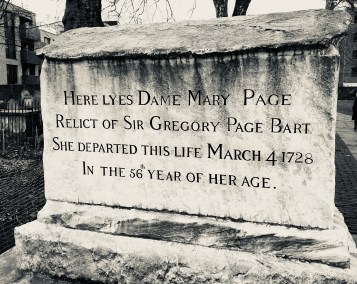 So before we leave our graveyard, let us take a final look around. We may see toys, flowers, photographs, candles and other personal artefacts placed carefully around the graves. They reassure the absent (and, of course, those that remain) and ‘link the tangible present to an intangible past (and future) of imaginary times and spaces’ (Clements, p.476). They also invite stories; and, with the epitaphs and inscriptions, offer clues and plot-lines that we craft into narratives breathing life into those that lie beneath us.
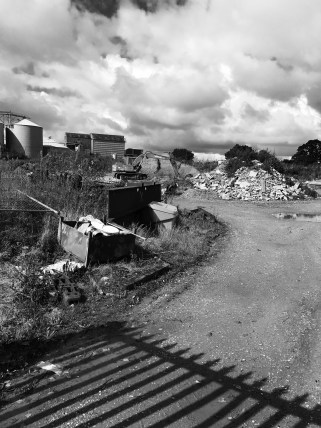
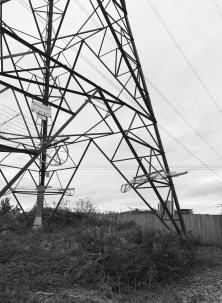 These edge lands – where ‘urban and rural negotiate their borders’ (Farley and Roberts, loc 183) – seem no more than ‘repositories for functions we prefer not to think about’ (Shoard, p.75). Gasometers, electricity sub-stations, security lit business parks, car pounds, sewage works, pylons, razor-tipped fencing and marshalling yards. They circle our towns and cities: uneasy crossing places haunted by ‘the neglected, the disposed of, and the repressed’ (Edensor, p.833). But, if we look carefully and without prejudice, we can recast these ‘unobserved parts of our share landscape as places of possibility, mystery, beauty’ (Farley and Roberts loc 198).
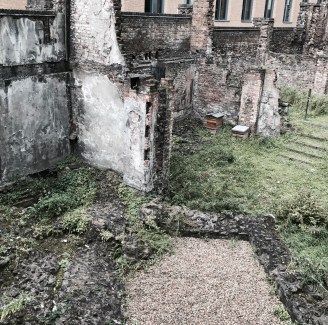 For look beyond the abandoned pallets and rusty JCBs, and vitality, energy and creativity emerge. What more could we expect in the marginal and liminal? Marion Shoard argues how edgelands are rich in plant and wildlife diversity: protected, forgotten and free of monoculture, pesticides and our compulsion to trim and prune. Similarly, Richard Mabey tells how rosebay willow herb and other ‘weed tenantry – ‘green and golden fennel and ragwort, coltsfoot, purple loosestrife’ – proliferated in the bombed out City warehouses and offices of the Blitz (Mabey, p.216). Glimpses of these ruderal fireweeds can still be found. By the
  Even in one building though, we can locate edgelands. Think of lifts, basements, the maintenance workshop or, indeed, the humble photocopier room. Utilitarian in design and decor, it seldom provides a home to the artwork that decorates other walls or offers panoramic views of tower and sky. But, as wasteland attracts the detritus we casually discard there – fridges, tyres, thieved and ransacked slot machines – so here we find the box of Christmas decorations and a rag-tag of superseded office equipment. And, as we know from apocryphal tales of office parties, these humble backwaters generate their own transgressive stories.
 Liminal Narratives