Carol

A Christmas Carol is a story spiced with the liminal. Scrooge, the not so eager and compliant liminar, is spatially and temporally removed from his everyday surroundings, counselled by wise and patient mentors, and emerges so transformed that a bewildered Bob Cratchit considers knocking him down with a ruler and ‘calling the people in the court for help and a strait-waistcoat’. And just as initiates in a rite of passage are structurally indiscernible (van Gennep, 1960 [1909]) (Turner, 1967), so Scrooge is literally invisible: as the Ghost of Christmas Past cautions him, the figures they encounter ‘have no consciousness of us’.

The liminal theme is introduced in the first sentence: ‘Marley was dead: to begin with’. But this point, like the coffin-nails to which the narrator refers, is repeatedly hammered home over the subsequent four paragraphs. The consequent doubt that arises through such over emphasis, rather than confirming the distinctions of life and death, intimates that such categories are not as fixed and immutable as we might optimistically imagine. And this classificatory uncertainty resonates through the whole novella as a tonal accompaniment to the state of anti-structure into which Scrooge progressively succumbs.

Indeed, even the weather confirms this sense of ambiguity. The fog — that ‘came pouring in at every chink and keyhole’ of Scrooge’s counting house — conceals and confuses. Even though ‘the court was of the narrowest’, the houses opposite are transmuted into ‘mere phantoms’ with the material and substantial rendered immaterial and insubstantial
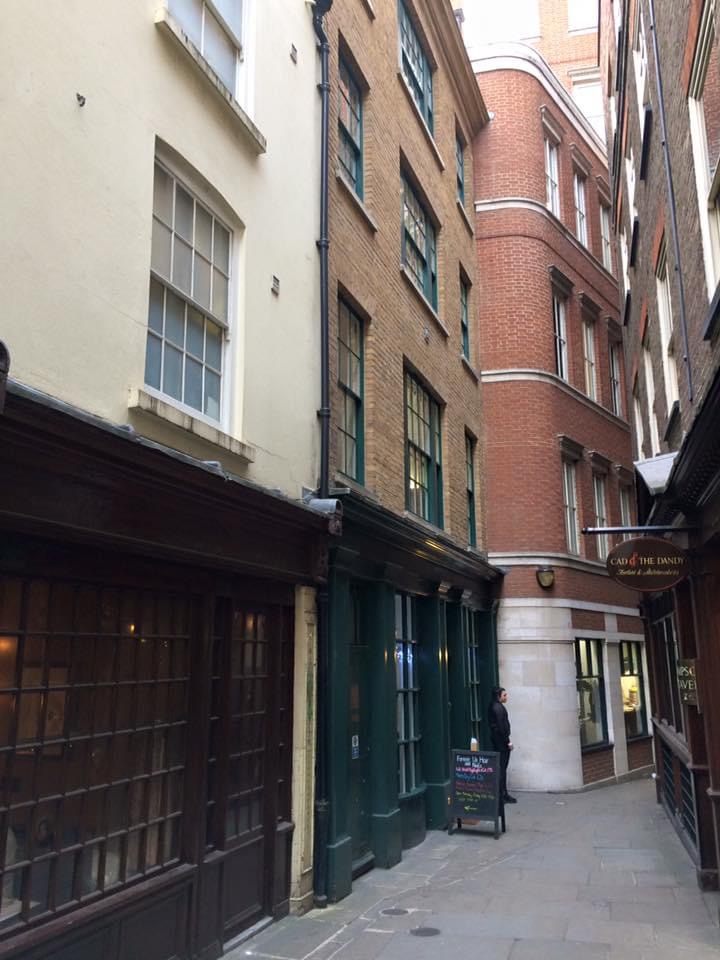
Ball’s Court Alley, City of London. The location of Scrooge’s counting house perhaps?

And, of course, ‘phantoms’ are at the heart of A Christmas Carol. But not just one but three — and, ghosts, as we have seen, are spectres of the liminal. As the ‘non-object, this non-present present, this being-there of an absent or departed one’ (Derrida, quoted in Orr, 2014, p. 1055), they ‘elide the distance between the actual and the imagined’ so that ‘frail and cherished distinctions collapse’ (Beer, quoted in Jackson, 1981, p. 69). And this particular ghostly trio of ghosts intensifies such ambiguity as the present is haunted, not just by the past but the future, and in a further dissolution of expected categories, by its own doppelganger: the Ghost of Christmas Present.

And let us consider too where we encounter the first spectre in the story. As Scrooge stands in the ‘fog and frost’ by the ‘black old gateway’ to his ‘gloomy suite of rooms’, the door knocker transforms into the face of Marley. The threshold, with its implication of a margin or edge between two states or spaces and the possibility of transition between the two, is the archetypal liminal space — Scrooge’s former business partner could hardly have selected a more symbolically resonant location in which to (de)materialise. And this ghostly preference for spaces betwixt and between the interior and exterior is confirmed by Marley’s phantasmal companions who appear at Scrooge’s window ‘wandering hither and thither in restless haste, and moaning as they went’.

But A Christmas Carol is also, in many ways, a story of organisational practices. After all it starts and ends in Scooge’s counting house and offers a case study of both organisational and leadership change — even if the methodology deployed is unlikely to feature in any management textbook. And within this we can identify two intriguing examples of how organisational space is enacted as liminal. The first is glimpsed only briefly. After an invigorating Christmas Eve berating his nephew, two gentlemen calling for charitable donations and his brow-beaten clerk, Scrooge retires to a ‘melancholy tavern’ to take a ‘melancholy dinner’ and then ‘beguiled the rest of the evening with his banker’s book’. Perhaps this is an early example of ‘fluid and fissiparous’ organisational boundaries as work strays outside the counting house to colonise a space of social interaction: the ‘inside’ goes ‘outside’ (Fleming and Spicer, 2004, p. 79). Instead of a ‘squeezing, wrenching, grasping, scraping, clutching, covetous old sinner’, perhaps we should re-imagine Scrooge as an early adopter of mobile working. Replace the ‘melancholy tavern’ with a bright and festive Starbucks and his ‘banker’s book’ with a laptop (though I doubt it would be the latest model) and he is recast as one of Costas’ ‘kinetic elites’, adroitly navigating the porosity of work and non-work boundaries (Costas, 2013).
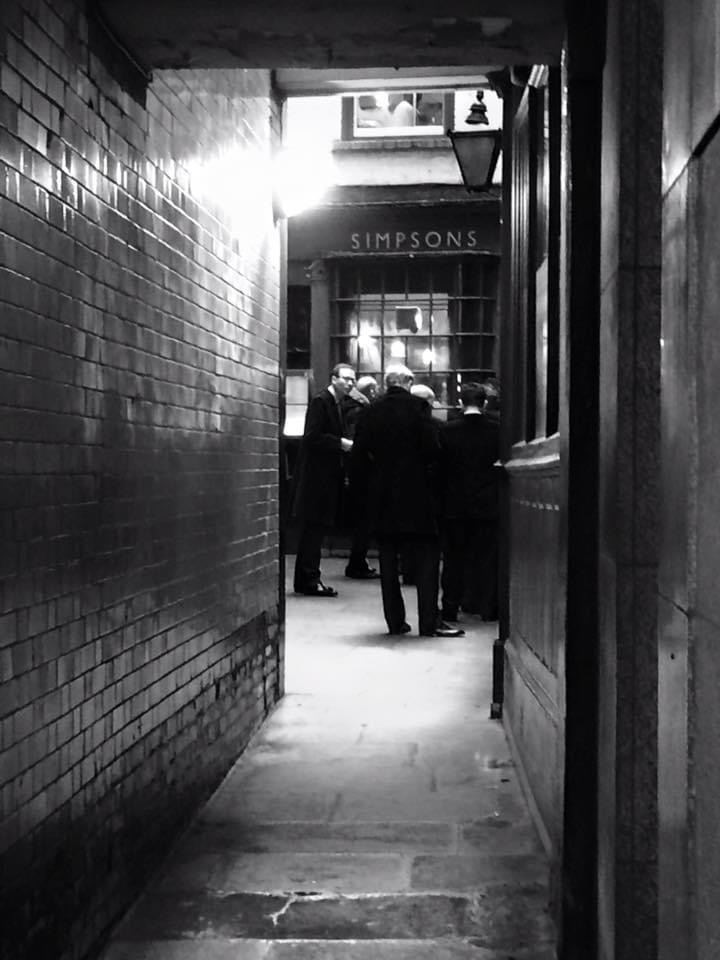
Simpsons, City of London. The ‘melancholy tavern’?

But if that is too much of an imaginative leap, let us explore the ‘office Christmas party’ hosted by Fezziwig, Scrooge’s beloved first employer. Such parties comprise both work and not work: a ‘relatively free space in which people can and do play, but it is also a space in which ‘fun’ has been institutionalized’ (Rosen, p. 468). Such a space can sanction the suspension or inversion of organisational hierarchies and the promise of transgressive activities such as dance, music, food and performance (although, as Hancock (2023) notes, such parties in the contemporary workplace are proving increasingly problematic). The confusion of work and non-work distinctions is pre-figured by the material transformation of the workplace as ‘every moveable was packed off…the floor was swept and watered, the lamps were trimmed, fuel was heaped upon the fire; and the warehouse was as snug, and warm, and dry, and bright as a ball-room’. Like Rothenburg’s Polish bar that shapeshifts from cafe to restaurant to nightclub during the course of the day (2000), so the identity of Scrooge’s place of work is rendered equally problematic: simultaneously both warehouse and ball-room. But the blurring of categories is short-lived. Following the forfeits, the porter, the Cold Roast and Cold Boiled, the dancing and the fiddling, as the clock strikes eleven, this ‘domestic ball broke up’ and, as the guests depart and the ‘cheerful voices died away’, Scrooge and his fellow apprentice, Dick ‘were left to their beds; which were under a counter in the back-shop’. After the liminal inversion of organisational norms, order and customary practice is restored — for, as Turner observes, liminal phases ‘invert but do not usually subvert the status quo’ (Turner, 1982, p. 42). Once the carnival is over, ‘normal order is quickly and completely restored’ (Rippin, quoting Bakhtin, p. 824).

And this brings us to the close of the novella as we return to Scrooge’s counting house. And here, the boundaries between work and social activities are once more subverted. But if earlier the workplace strayed outside to the tavern, the home has now strayed inside the office (see Attlee, 2022). The transformation of Scrooge’s leadership style (from directive and pace-setting to affiliative perhaps) is mirrored by the replacement of typical organisational activities — copying, accounting, drafting — with the more social, domestic behaviours of drinking a ‘bowl of smoking bishop’ by a roaring fire. Yet, if we view the unfolding of the story as a carnivalesque, liminal experience, normal service is all too quickly resumed. For despite Scrooge’s feelgood rite of passage, as Hancock intimates, the status quo of commerce, consumption and market economics emerge unscathed, if not reinforced (2023). Fittingly, for a tale where certainties dissolve and elide, it is a tale where both everything — and perhaps nothing — changes.

Attlee, E. (2022) Strayed homes: cultural histories of the domestic in public. London: Bloomsbury Visual Arts.

Costas, J. (2013) ‘Problematizing mobility: a metaphor of stickiness, non-places and the kinetic elite’, Organization Studies, 34(10), pp. 1467–1485.

Dickens, C. (1971) The Christmas books: volume one. London: Penguin.

Fleming, P. and Spicer, A. (2004) ”You can checkout anytime, but you can never leave’: spatial boundaries in a high commitment organization’, Human Relations, 57(1), pp. 75–94.

Hancock, P. (2023) Organizing Christmas. New York: Routledge.

Jackson, J. (1981) Fantasy: the literature of subversion. London: Methuen.

Orr, K. (2014) ‘Local Government Chief Executives ’, Everyday hauntings : towards a theory of organizational ghosts’, Organization Studies, 35(7), pp. 1041–1061.

Rippin, A. (2011) ‘Ritualized Christmas headgear or “Pass me the tinsel, mother: it’s the office party tonight’, Organization, 18(6), pp. 823–832.

Rosen, M. (1988) ‘You asked for it: Christmas at the bosses’ expense’, Journal of Management Studies, 25(5), pp. 463–480.

Rottenburg, R. (2000) ‘Sitting in a bar’, Studies in Cultures, Organizations and Societies, 6(1), pp. 87–100.

Turner, V. (1967) The forest of symbols: aspects of Ndembu ritual. Ithaca, NY: Cornell University Press.

Turner, V. (1982) From ritual to theatre: the human seriousness of play. New York: PAJ Publications.

Van Gennep, A. (1960[1909]) The rites of passage. Translated by M.K. Vizedom and G.L. Caffee. London: Routledge and Kegan Paul.
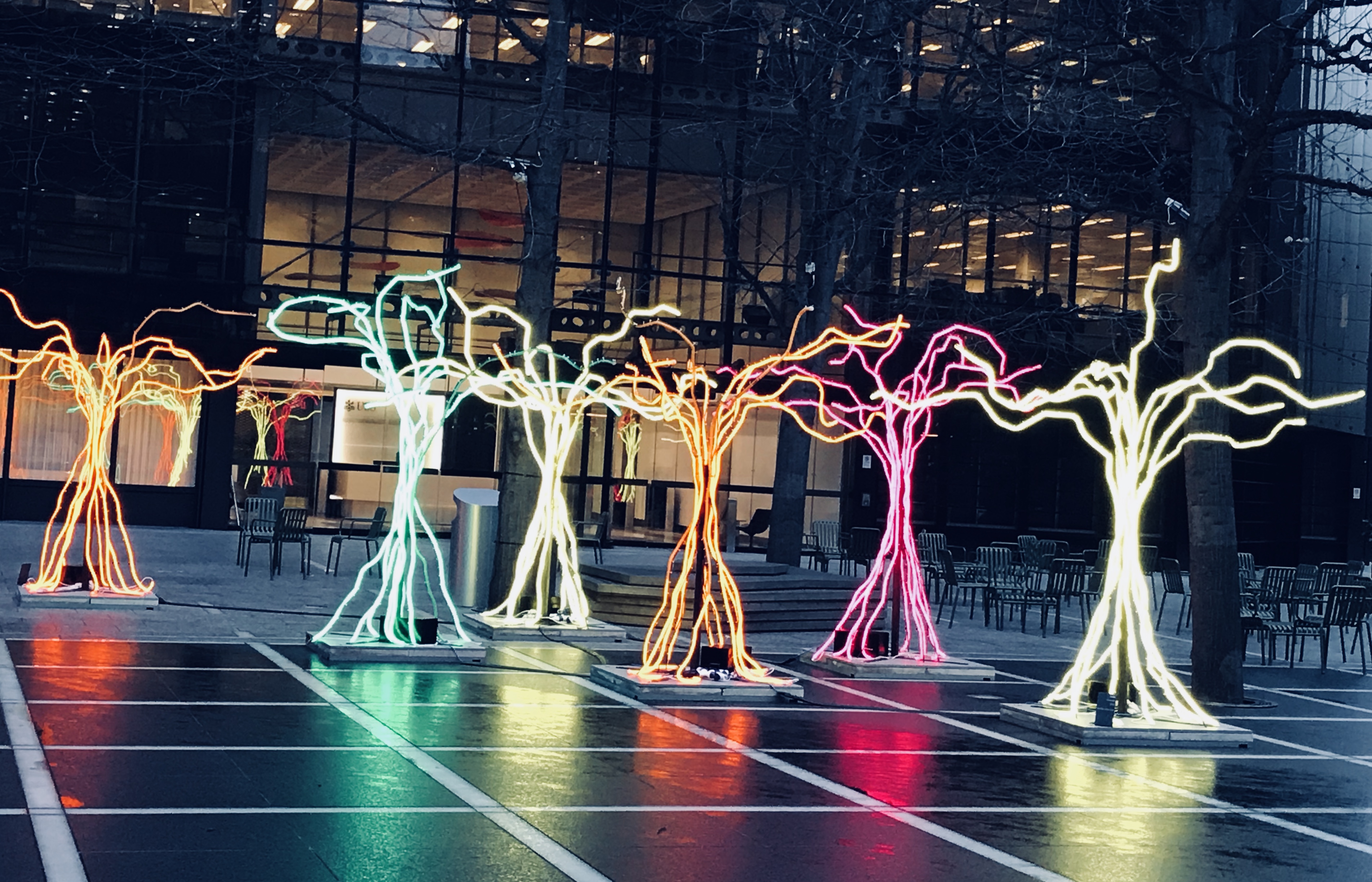
Christmastide

Stories of the nativity are stories of the liminal.  A baby – both corporal and divine – born of a virgin in a place that belongs ‘partly to animals and partly to humans’ – neither a ‘house nor the open air’ – and worshipped both by royal magi and lowly shepherds. As Hutton notes, this birth of a hero occurs ‘at the junction of many worlds’ (Hutton, loc 207). The uncertainty of the betwixt and the between suffuses the days of December and beyond. At midwinter, as at midsummer, the sun appears to rise and set in the same place for several days (this is the solstice – the time when the sun stands still). In the pagan Roman calendar, this period was a ‘quiet and mysterious one’ bordered by two festivals: Saturnalia and the Kalandae (Hutton, loc 241).

Christmas1

For the days of Advent are days of both preparation and closure. The year is dying with a new year soon to be born.  This is a season that slips the net of classification: it assumes, like the liminal persona in a rite of passage, both the symbols of death and decomposition and those of growth and regeneration (Turner, 1967). The green yew that decks the ‘altar, font and arch and pew’ (Betjeman, p.41) defies the withered leaves strewn on the gravel path outside.

And so these days reflect not only a Christian mythology but a parallel tradition. Hutton argues that there is sufficient evidence from Anglo-Saxon, Viking and Welsh heritage to argue for a major pre-Christian festival ‘marking the opening of the new year, at the moment at which the sun had reached the winter solstice and its strength was being renewed’ (Hutton, loc 386). This duality – this intertwining – is seen in how, before 1038, the feast of the Nativity was starkly described in Anglo-Saxon literature as ‘midwinter’ (midne winter or middum wintra)’ (Hutton, loc 329). Christmas is yet to appear.

When we view our organisations through the kaleidoscope of these traditions, such liminality transforms and transmutes. In their study of the sacrilization of Christmas commerce, Bartunek and Do see a complex interplay between the sacred and the profane. This is not just a simple paradox intertwining a Christian holy day and a secular occasion for commerce. Rather, the ‘paradox of Christmas is that organized commercialism has become sacred, and the religious experience of Christmas has lost a good deal of its sacred character’ (Bartunek and Do, p.803).

And, as a liminal time, is it any surprise that the organisational Christmas is marked by rite and ritual? Speaking to friends and colleagues, they revealed the Christmas work customs they enjoyed. The responses were varied. The donning of Christmas jumpers, ‘secret Santa’, home-made treats communally shared, mince pies in the meeting rooms, a seasonal quiz over lunch, directors serving lunch in the staff restaurant. Their eager emails hinted at the sense of belonging and conviviality such customs engendered. Burtunek and Do identify how Durkheim’s definition of the sacred includes the set-apart which has no connection to the supernatural or religious. Rather, it involves beliefs, rituals and duties that comprise a ‘symbolic projection of the group identity’ and provide a ‘source of social cohesion (Bartunek and Do, p.796). So, maybe, we should re-appraise these seemingly trivial customs – not trivial but sanctified by the sacred?

If we look hard enough, we see further evergreen evidence of the betwixt and between. In his study of a Christmas party at a US advertising agency, Rosen categorises the event as both a ‘party’ and an ‘organisational activity’.  It is both work and not work: a ‘relatively free space in which people can and do play, but it is also a space in which ‘fun’ has been institutionalized’ (Rosen, p.468). Such parties are surely similar to the business dinners we encountered in an earlier post on restaurants: they are ‘liminal spaces where the burden of many of the rationalistic rituals of the organisation is suspended, lessened or proscribed’ (Sturdy et al, p.930).

Christmas3

And, of course, the party is also a space for transgression. It integrates ‘dance, music, food, alcohol, performance, laughter, sex and talk’ where the ‘hierarchically arranged relationships of the office are to a degree stripped and levelled during and through play’. (Rosen, p.468). Like the directors serving dinner (a tradition mirrored by officers serving Christmas lunch to the ranks), the hierarchy becomes, albeit temporarily, topsy-turvy. For, as Turner observes, the liminal phases ‘invert but do not usually subvert the status quo’ (Turner, 1982, p.42). When the lunch ends, the roles reverse again; and this time for good. For Rippin, such formalised misrule is a feature of carnival and, quoting Bakhtin, once the carnival is over, the ‘normal order is quickly and completely restored’ (Rippin, p.824).

Maybe such rituals are betwixt and between time too. Their modernity conceals deeper roots: older, sometimes darker, traditions. Hutton shows how the the misrule involved in role reversal reaches back in time to the Saturnalia, the Feast of Fools, the tradition of the Boy Bishop and the school custom of ‘barring out’. In an entertaining analysis of how festive headgear helps us understand contemporary organisational rituals, Rippin sees the humble paper hat – our modern manifestation of a magi’s crown – as symbolic of this power to be king for a day (Rippin, p.825). She also identifies the office Christmas party as a convergence of two further traditions: the feasting of craft guilds and the donning of disguise. The mummer – or ‘guiser’ – took advantage of their camouflage to entertain and/or extort money as they visited door to door. Their behaviour was frequently ‘lively’: at the end of December 1657, a west countryman called Frome complained that he had been beaten up on the 26th by a group who had been ‘drinking, playing cards, and fiddling all day in disguised habits’ (Hutton, loc 698). In my area of East Anglia during the 19th century, agricultural workers engaged in a winter street performance called Molly dancing.

Disguised with blackened faces and women’s clothing, they performed versions of local social dances in exchange for largesse. They could be destructive, drunk and disreputable in appearance. (Bradtke, p.199)

Is it but a step from such guising to the weaving office workers navigating from pub to pub, paper crowns, tinsel halos, Father Christmas hats and reindeer antlers jauntily – or forlornly – displayed? For Rippin, such reindeer antlers reach further back in time. They represent the ‘reintroduction of masculine, ‘natural’, unmediated nature into organizations’ (p.892). They belong to the ‘Green Man whose function might be to bring new vigour to moribund organizations’. This brings yet another liminal turn; for, as we have seen, the Green Man thrives in the margins; the corners; the places we overlook. He is also of all time and every time: our tinsel, baubles and lights mere kitsch simulacra of a face wreathed in ivy, holly, laurel and bay.

To end where we began. Both the liminal and midwinter breathe stories, so here is one I heard many years ago. A friend told of three senior consultants from his company who had travelled to the States to research new clients. As they travelled through tumbleweed states from business to business, the three consultants drove through the December night and dusty, abandoned towns: one at the wheel, one navigating, one asleep. And finally their perseverance brought success in the form of a new account. So why did such a simple tale take such deep roots in my memory? Perhaps because it is a secular re-telling of the Journey of the Magi. Three wise men (for they were, sadly, all men), royalty in their own organisation, who came from the East and endured hardship and a long, sore journey before they found a salvation (of sorts).  So, just as Eliot recast a sermon by Lancelot Andrewes, ancient stories are reinvented for modern times: the ending never written; forever betwixt and between.

‘A cold coming we had of it,

Just the worst time of the year

For a journey, and such a long journey:

The ways deep and the weather sharp,

The very dead of winter.’

(Eliot, p.97)

Bartunek, J. M. and Do, B. (2011) ‘The sacralization of Christmas commerce’, Organization, 18(6), pp. 795–806.

Betjeman, J. (2006) ‘Christmas’, in Williams H. (editor) John Betjeman. Faber.

Bradtke, E. (1999), Truculent Rustics: Molly dancing in East Anglia before 1940. The Folklore Society.

Eliot, T.S. (1954) ‘Journey of the Magi’, in Selected Poems: Faber, pp. 81-93.

Hutton, R. (1996), The Stations of the Sun: a History of the Ritual Year in Britain. Oxford University Press.

Rippin, A. (2011) ‘Ritualized Christmas headgear or “Pass me the tinsel, mother: it’s the office party tonight’, Organization, 18(6), pp. 823–832.

Rosen, M. (1988) ‘You asked for it: Christmas at the bosses’ expense’, Journal of Management Studies, 25(5), pp. 463–480.

Sturdy, A. Schwarz, M. Spicer, A. (2006) ‘Guess who’s coming to dinner? Structures and uses of liminality in strategic management consultancy’, Human Relations, 59(7), pp. 929–960.

Turner, V. (1967), The Forest of Symbols: Aspects of Ndembu Ritual. Cornell University Press.

Turner, V. (1982), From Ritual to Theatre: The Human Seriousness of Play. PAJ Publications.