Window

Window

In her introduction to the excellent anthology of essays – Thinking on thresholds: the poetics of transitive spaces – Subha Mukerji refers to the ‘mesmeric quality of the threshold’ (Mukerji, p. xxi) and the ‘elusive but crucial experiences at a variety of boundaries’ (p. xix).  Later in the book  the theme is developed by Gillian Beer in her thoughtful analysis of windows and their uses and meanings in literature.  They are a ‘liminal connection between inner and outer’ (Beer, p.3). Windows link and separate; provide access yet exclude; are both medium and barrier.  Incidentally, they are also places of concealment and Beer evokes the image of a spy mounting surveillance on the world beyond.  Or a voyeur perhaps – which suggests our flaneur, peering through the shop windows in a Parisian arcade: detached and distant, the spy without.

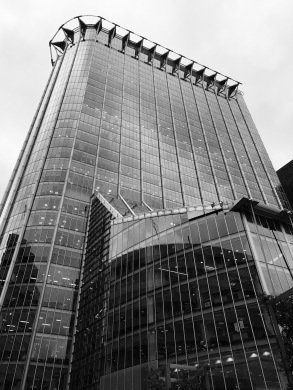
It made me think how office buildings often reflect rather than reveal.  They are more looking glass than window.  What you see is where you are rather than where you want to be. The organisation within is secluded and the story it might tell literally a closed book.

But more disturbing than the window as looking glass is the room deprived of windows.  In reference to new office buildings, Beer notes how windows are often ‘done away with’ and how ‘rooms entirely without windows have been traditionally understood as sinister or subjected…the presence of windows brings the light of the outside world to bear on what is happening in the room’ (p.6).  How many meetings have you sat through and how many training sessions endured in cell like chambers?  How can ideas, imagination, creativity flourish if the light of the outside world (or rather, enlightenment) is denied.  If we see the threshold as ‘mesmeric’, a place of liminal connection and transformation, then it is surely perverse to plasterboard it over.  How ironic that in exhorting our colleagues to – and it’s a ghastly phrase I know – ‘think outside the box’, we encourage this by placing them in the very box their imaginations are required to escape from.

But office windows can be creative in other ways too.  As you wander the corridors – an organisational flaneur perhaps? – you may peek through the windows of the offices you pass.  The door is closed; figures gather around a table and a phone; their looks may tell of frustration, excitement, anxiety.  What’s going on?  If the combination of figures is puzzling – so why are x and y meeting up? – then our irresistible urge to spin a narrative takes hold once more.  We formulate a plot, a causal and temporal chain of connection that explains these vexing stimuli.  We are excluded yet involved and perhaps it is this ambiguous, liminal state that stimulates our imaginations.

In her analysis of Yeats’s poem ‘Ego Domimus Tuus’, Beer deconstructs the image of the poet Keats ‘with face and nose pressed to a sweet-shop window’.  But it is this ‘gap between nose and the sweets, the cold glass between’ that stimulates ‘Luxuriant song’ (p. 8).  It is the threshold that excites poetry.

And so too in our offices.  We may view our windows as organisational prose – boring, formulaic, transparent (in more ways than one) – but are they also not coated with a thin film of poetry? Not just windows but Keats’s very own ‘Charm’d magic casements’ that open on our ‘faery lands forlorn’ (Gittings, p.126)?

Beer, G. (2011) ‘Windows: Looking In, Looking Out, Breaking Through’, in Mukerji, S. (ed.)  Thinking on Thresholds: the Poetics of Transitive Spaces.  Anthem Press.

Gittings, R. (ed.) (1966) Selected Poems and Letters of John Keats. Heinemann.

Mukerji, S. (2011) ‘Introduction: Thinking on Thresholds’, in Mukerji, S. (ed.)  Thinking on Thresholds: the Poetics of Transitive Spaces.  Anthem Press.
flâneur

FullSizeRender 2

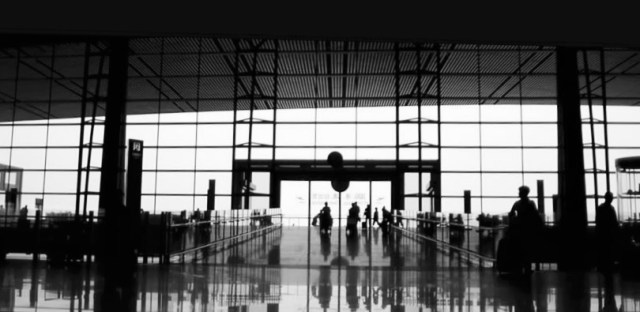
In airport, we looked at how Augé’s non-places are maybe not so ‘non’.  They are places not merely of circulation, communication and consumption but creativity too.  This suggests perhaps a further liminal characteristic of non-places – their identity is not merely singular but multiple; and these identities blur.  It is a view proposed by Peter Merriman in his exploration of the geographies of the M1 motorway.  He views these landscapes – airports, shopping malls, service stations – as “more complex, heterogeneous and multiplicitous” than Augé suggests (Merriman, p. 160).   For an example, in an airport frequent flyers, flight crews, air traffic controllers, baggage handlers, first-time flyers are likely to have “different experiences of movement, dwelling, familiarity and belonging” (Merriman, p.152).

But how do stories relate to these non or non-non places?  Imagine you are passing through an airport or railway terminus (which, by the way, seem increasingly happy to erase their history – their existence as anthropological space – by assuming a shopping mall identity).  Do you ever wonder about the travellers you see?  Who they are, where they have come from, where they are going?  You may spot clues, clothing for example.  Shorts in January suggests Dubai rather than Finland.  As you board the railway carriage, you see a passenger manoeuvring a suitcase with the baggage label still attached.  Are ever you tempted to take a peek?

Snatches of conversation provide other evidence.  Marooned at Singapore airport for several hours, I amused myself by trying to work out a narrative to explain the American family who, in an obvious hurry, joined the cafe table next to me.  They barely had time to devour the food they had purchased, before the mother, anxious not to miss a connecting flight, herded her protesting husband and children down the corridor, cups spilling on the abandoned table and half-consumed wraps stuffed into pockets and rucksacks.

Karl Weick notes how stories “impose a formal coherence on what is otherwise a flowing soup” (Weick, p.128).  They gather strands of experience into a “plot that produces an outcome” and such “sequence is the source of sense”.  By imposing a temporal frame of past, future and present we can comprehend the random, multiple and puzzling.  The stories we create to explain our fellow travellers is a way to contain this ‘soup’.

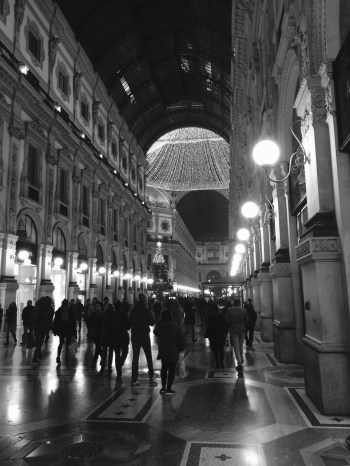
In doing so, perhaps we also become contemporary flâneurs.  This stroller among the crowds of 19th century Paris was “a figure keenly aware of the bustle of modern life” (Shaya, p.47).  Their natural habitat was, as Walter Benjamin described, “the arcades…glass-covered, marble-panelled passageways…lighted from above…lined with the most elegant shops…so that such an arcade is a city, even a world, in miniature” (pp.36-37).  Rather like a modern airport perhaps?  In Benjamin’s study of the poet Baudelaire he observes that, for the flâneur, “the joy of watching is triumphant…the result is the amateur detective.”  He highlights Baudelaire’s translation of the Edgar Allan Poe story The Man of the Crowd, where the narrator, installed the behind a window of a London coffee-house watches the passing throng.  From here, he makes deductions, mini-narratives, from the details he observes: a man whose ears stick out indicates he must be a clerk who stores his pen behind his ears.  And what does a detective do but turn “equivocal happenings into meaningful stories characterized by a distinctive plot” (Patriotta, p. 369)?

So, as we sip our espresso in the ‘open air’ cafe of a shopping mall; tap away at our laptop in an airport lounge or wait on the concourse for our invariably delayed train to arrive – we are not just ‘customers’, ‘passengers’, ‘commuters’ but also the true and noble descendants of the frock-coated, top-hatted flâneur.  Observing, watching, making our deductions and spinning our stories to explain the passing, random and confusing bustle around us.

Benjamin, W. (1983). Charles Baudelaire: A Lyric Poet in the Era of High Capitalism. Verso

Merriman, P. (2004) ‘Driving Places’, Theory, Culture & Society. 21(4–5), pp. 145–167.

Patriotta, G. (2003) ‘Sensemaking on the Shop Floor: Narratives of Knowledge in Organizations’, Journal of Management Studies. 40(2), pp. 349–375.

Shaya, G. (2004) ‘The Flaneur, the Badaud, and the Making of a Mass Public in France, circa 1860-1910’, The American Historical Review, 109(1), pp. 41–77.

Weick, K.E. (1995). Sense making in Organisations. Sage.

Airport

Airport2

In an endlessly fascinating essay – Non-places: an introduction to super modernity –  Marc Augé contrasts anthropological place (any space bearing the inscriptions of the social bond or collective history, such as churches, market places and town halls) with non-places.  Described as spaces of circulation, consumption and communication, they are the places we inhabit when we “are driving down the motorway, wandering through the supermarket or siting in an airport waiting for the next flight to London or Marseille” (Augé, p.77).

As a reasonably regular traveller, the airport as non-place strikes a distinct and suitably muzak tinged chord.  For Augé, one of the characteristic features of non-places is their ability to dislocate identity.   So let’s consider our arrival at Heathrow departures.  It is not our intelligence, our wit, our skill to strip a motor engine, paint a watercolour or craft a 50 metre cross-field pass that ensures our safe transit via the various contractual crossing points that confront us: check-in desk, security, passport control, final airline  check before boarding the plane.

Such negotiation is only ensured by reducing our identity to its essence.  A passport (bearing a photo, a number, a code) that then secures us a secondary identity: the boarding pass.  Picking up Augé’s argument, the traveller is “relieved of his usual determinants” (Augé, p.83).  He assumes a temporary identity yet one that echoes those of other travellers.  We respond to the “same code as others…the same messages…the same entreaties” –  proceed to gate 4, rows 5-8 boarding now.  It is a state of both “solitude and similitude”.

This reduction in identity relates to Victor Turner’s analysis of the liminal stage in rites of passage.  The neophytes undergoing this transition are reduced to nothing – they are stripped of their property, insignia, rank and kinship position.  There is “nothing to demarcate them structurally from their fellows” (Turner, pp. 98-99).  So, maybe a non-place is also a liminal place.  Or, as Kociatkiewicz and Kostera note, a “transitional space” –  the space “waiting for liminality to happen” (Kociatkiewicz and Kostera, p.7).

This highlights a further feature of non-places.  Augé observes that the relative anonymity afforded by the temporary identity assumed in non-places can be felt as a liberation.  For Augé, this is a negative liberation consisting merely of the power to refrain from making decisions, to submit to order and control.  Yet maybe there is genuine liberation here.  The liminality described by Turner is not only a condition of ambiguity and paradox; but also one of growth and transformation.  For there are some – myself included – who experience the anonymity of the airport as conducive to thought, reflection, insight.  I find them stimulating places to work – freed from the the everyday, the burden of multiple identities and responsibility.  The mind relaxes and opens itself to possibilities. So, perhaps heretically, non-places are not merely spaces of circulation, communication and consumption but refuge also to another ‘C’; that of creativity.

Augé, M. (2008), Non-Places: An Introduction to Supermodernity. Verso.

Kociatkiewicz, J., Kostera, K, (2011) ‘Transitional Space’, Tamara Journal for Critical Organisation Inquiry, 9(3-4), pp. 7-9.

Turner, V. (1967), The Forest of Symbols: Aspects of Ndembu Ritual. Cornell University Press.

Trickster

Tarot Card b:w

Once upon a time I heard a story.  It was a simple one told by a senior executive.  Speaking of his early days in the company, he recalled a managing director who was an anxious, nervous type.  Indeed, the restless and constant shuffling of his shoes against the carpet under his desk had “rubbed it through to the concrete beneath”. As a junior, our narrator told of his disquiet at having to deal with this important but challenging individual.  However, he spoke in admiration of the director’s secretary who faced with the injunction that every job was a crucial one requiring immediate attention would cheerfully file the offending paperwork at the bottom of a teetering pile.  It would then be dealt with at a time of her choosing – maybe weeks in the future.  Meanwhile, she would pacify the director with a soothing “of course, I’m doing it now” while sagely sequencing the outstanding tasks with a calm and unruffled efficiency.

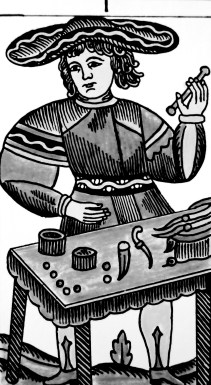
I thought of this secretary when reading Gabriel’s account of the trickster (Gabriel, 2000: 77).  This archetype of mythology and folklore deals with challenges and problems with native cunning and wit.  From the tortoise outsmarting the hare to Jerry confounding a frustrated Tom to the black market wheeler dealer Private Walker in Dad’s Army.  All use their intelligence and native slyness to outfox the seemingly more talented, conventionally intelligent or more hierarchically important.  Here the secretary subtly subverts the power of the managing director – she is the one making the decisions as to what is important.  But she works, not through confrontation or rebellion, but through a sustained confidence trick: the director never knows he is being duped.

I’m sure we all know similar organisational tricksters who, as Kets de Vries observed (1990:758) can be seen as “both underdog and culture hero”.  They demonstrate that those in the margins or backwaters of organisational life can still thwart authority and assert their own independence and autonomy.  Through disobeying rules, ignoring what is expected and transgressing boundaries, they provide templates as to how we can similarly aspire to act.  They are, indeed, our heroes.

Elsewhere, Kets de Vries (2017) views the trickster as a “mythical embodiment of ambiguity, ambivalence, duplicity, contradiction and paradox.”  So is our trickster also a liminal character?  Both underdog yet hero; marginal yet central; administrative yet creative.  The trickster is literally a shapeshifter: both one and other.  And as Kets de Vries observes, as a figure of chaos, the trickster helps “promote new ideas, foster new experiences, new wisdoms and new insights.”  So maybe, in our VUCA world of volatility, uncertainty, complexity and ambiguity, we should celebrate out organisational tricksters.  Their cunning, intuition, sense of survival and bravery are maybe exactly the qualities needed to spark innovative thinking, unleash unexpected stratagems and rejuvenate the atrophy of accepted wisdom.  So celebrate your trickster stories for they, perhaps, may ensure and safeguard our future.

Gabriel, G. (2000), Storytelling in Organisations: Facts, Fictions, and Fantasies: Oxford University Press.

Kets de Vries, M.F.R. (1999), ‘The Organizational Fool: Balancing a Leader’s Hubris’, Human Relations 43/8:751-70.

Kets de Vries, M. (2017) ‘Why every workplace needs a fool’, Insead blog, 3 February.  Available at http://knowledge.insead.edu/blog/insead-blog/why-every-workplace-needs-a-fool-5187 (Accessed: 8 April 2017).

Corridor

img_2552

The meeting ends.  Papers are collected, laptops closed, pens gathered and briefcases refilled.  You push back the chairs, retrieve coats and scarves and, trading true english courtesy, invite each to go through the door first.

Then something happens.

More often than not, the conversation – previously focussed on objectives, next steps and deadlines – then abruptly shifts gear.  You and your fellow conferees begin to talk about the journey home (“and where do you come in from?”), plans for the weekend or coming holidays.  It’s also the place where the stories emerge.  Such is the transformational magic of the corridor.

I remember once where, having immersed ourselves in serious topics for an hour, the three of us stepped out of our meeting room and the client immediately began a story about…and conscious about betraying confidences…a somewhat explosive end to a corporate dress-down day shortly before Christmas.  In that short story, I learnt more about the organisation – its culture, values, political niceties – than I could from any press search or annual report.

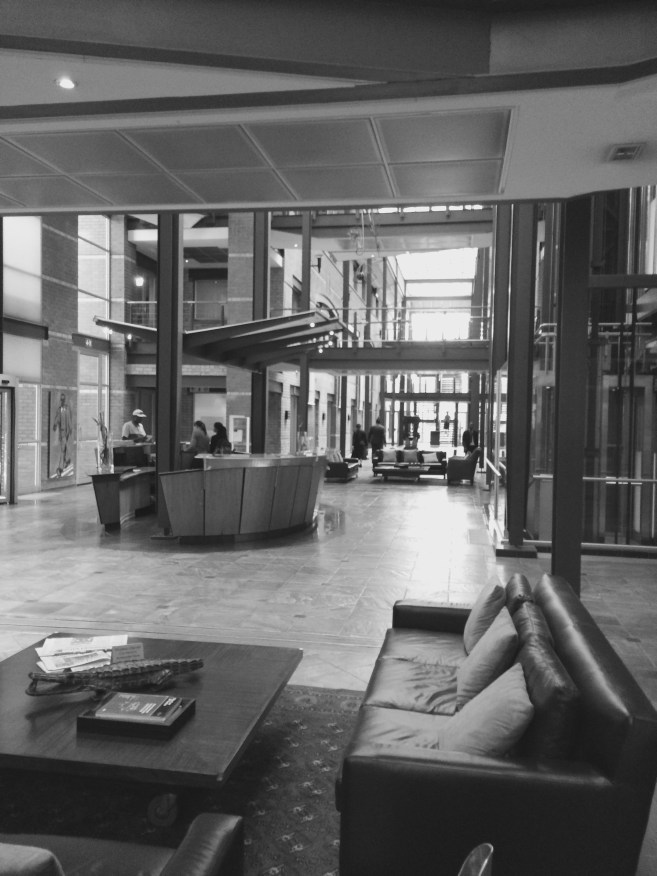
So why the corridor?  Maybe it’s the sudden opening of the physical environment after the confines of an enclosed room.  Such subconscious and metaphoric liberation might similarly loosen the chains on what we feel we can and should talk about.  Maybe, it’s the long vista that stretches into the distance and invites us out of our current state to somewhere else.

In this sense, the corridor is a liminal space.  A locale for transit, for movement and progression.  It leads from one place to another and not just in a physical sense but in a symbolic way too.  From the formal, serious room of discussion and commercial imperatives to the exit and a world of the normal, the day to day, the social.  And maybe, it’s this shapeshifting quality – still part of the business environment but one whose clarity is slightly blurred and out of focus –  that encourages different conversations and elicits our stories and tempts them out into the open.