Let us return to the corridor – intrigued and delighted by Rachel Hurdley’s Radio 4 broadcast, The hidden history of the corridor. Poised between public and private; open and closed; movement and stasis; the pragmatic and the eerie, corridors are ‘time and ‘matter out of place” (Hurdley, p.50). From one perspective, opening the door to the corridor provides release and stimulates new modes of thinking. In the broadcast, Sir Christopher Meyer tells how deadlock in political negotiations might be broken by small groups convening in the corridor during breaks and solving hitherto intransigent problems. Movement into different spaces engenders fluidity of both movement and thought. The dynamics of the formal meeting room are recast by the new space encountered.
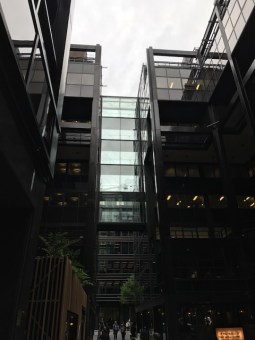 We have seen how the corridor is a place that welcomes storytelling. In other ways too, it is a space of production. Via a study of hospital staff interactions, Gonzalez-Martinez explores how medical staff use the corridors for brief and frequent conversations that rarely involve stops. The spaces are deployed for ‘informing someone of something; making enquiries about cases, colleagues or other matters; clinical conferring on a case; giving orders or instructions; making requests; checking how something is going; and offering help’ (Gonzalez-Martinez et al, p.525). Similarly, Hurdley shows how a printer in a university corridor becomes a meeting place for research students to chat (Hurdley, p.55). A place for transit is simultaneously one of congregation. Here, the edgelands of a corridor ‘garret’ are transformed from mundane sterility to fecund possibility.
This play between those who walk purposefully along the corridor and those who linger is teasingly suggested by a work of art in a certain City of London office. In the corridor outside the client meetings rooms run a line of artworks representing 3-D walking figures. As you approach the installation, the figures are static; however, as you walk past them, they leap into life keeping pace with you. When you stop, they stop. The convention of engaging with art through static contemplation is subverted: here, appreciation requires you to walk away. Preferably, quickly.
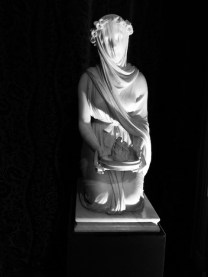 Of course, we could read this artwork in another way. By encouraging us to navigate the corridor in a physically prescribed way, we are reminded how space acts as the ‘materialization of power relations’ (Taylor and Spicer, p.330). In Hurdley’s broadcast, the curator of Tyntesfield House describes how the corridor to the ‘virgins’ wing’ (where the female servants lived) was ‘protected’ by the Foucaldian panopticon of the cook’s bedroom: the senitel who detects and deters transgressive behaviour. In other grand houses, corridors are used to demonstrate monetary wealth and cultural learning. At Chatsworth, the Chapel Corridor evokes a grand collector’s gallery bringing together sumptious art works from the Devonshire Collection.
And just as the 3-D installation subtly manipulates our physical movement along the corridor, such gentle coercion can be experienced in many museums and National Trust properties. Our progress is often determined by signs, barrier ropes and the room attendants (as vigilant as any cook monitoring a misbehaving maid). Such routing can also reflect a particular narrative about the exhibits and artefacts that we are encouraged to absorb. This ‘organised walking’ is a ‘form of control that incorporates both mind and body.’ (Dale and Burrell, p.72).
There are also other ways to experience corridors. As spaces for potential anxiety perhaps. We wait there anticipating the summons: a doctor’s examination; a promotional interview; a make or break presentation. As we sit (or pace), vainly attempting to control our nerves, perceptions are disturbed – like static on a badly tuned radio station – by recollections of previous meetings. No experience is wholly in the present – the past intrudes, whispers, infects.
In The hidden history of the corridor, Karen Krizanovich notes how films often instil corridors with a sense of dread and foreboding. Her cited example is The Shining and the famous sequence of Danny Torrance pedalling his tricycle along the deserted corridors of the Overlook Hotel. For Mark Fisher, the very subject of the film is the ‘experience of a time that is out of joint’ (Fisher, p.20). The Overlook is a place ‘whose corridors extend in time as well as space’.
A Swedish series, Black Lake, that is about to conclude on BBC4, draws on many of The Shining’s tropes and themes. A snow-bound lodge; revenants from a tainted past; and, of course, corridors. For Fisher, the eerie is ‘constituted by a failure of absence or by a failure of presence…where there is something present where there should be nothing.’ (Fisher, 2016, p.61). In Black Lake, a significant plot device is a door to the cellar that constantly opens of its own accord (so consistent with Fisher’s definition of the eerie). The corridor outside is monitored by a camera but here the attempt at control is subverted. At crucial moments, the camera is found to have been turned away. There is a nexus between the corridor and power; but there is uncertainty as to the source of the power. Is it natural or unnatural?
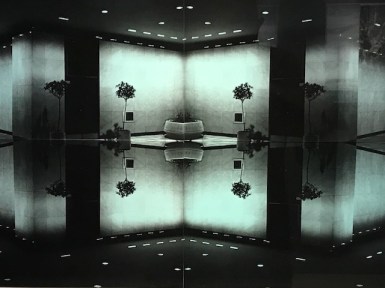 The scent of the uncanny also infuses our quotidian places of work. Should we ever visit after hours or at the week-end, they always invoke, I feel, a sense of the strange. And this is most apparent in the corridors: quiet, denuded, almost sentient in their calm. This effect heightens perception: sounds are subtly amplified; and the signage and art work somehow appear more prominent. We might attribute this to the failure of presence – ‘there is nothing present where there should be something’ (Fisher, p.61). This quality of the eerie is forensically explored by the artist Tim Head in a series of photographic collages showing de-humanised spaces: empty corporate receptions, hotel entrances, underground car parks. Enhanced by pale tinting, the collages portray the uncanny and alien while evoking the melancholy of lost and half-imagined futures.
So, the next time you walk along a corridor, just pause. Take time to look around and listen, breathe deep, touch. For this is not just a corridor. This is a space that materialises power, subversion, production, congregation, solitude, creativity, anxiety, movement, stasis, excitement, foreboding and, of course, liminality. It is a space where the ordinary becomes extraordinary.
Dale, K. and Burrell, G. (2008), The spaces of organisation & the organisation of space: power, identity & materiality at work. Palgrave Macmillan.
Fisher, M. (2012) ‘What is Hauntology’, Film Quarterly, 66(1), pp. 16–24.
Fisher, M. (2016), The weird and the eerie. Repeater Books.
González-Martínez, E., Bangerter, A., Lê Van, K. and Navarro, C. (2016) ‘Hospital staff corridor conversations: Work in passing’, Journal of Advanced Nursing, 72(3), pp. 521–532.
Hurdley, R. (2010) ‘The Power of Corridors: Connecting Doors, Mobilising Materials, Plotting Openness’, The Sociological Review, 58(1), pp. 45–64.
Taylor, S. and Spicer, A. (2007) ‘Time for space: A narrative review of research on organizational spaces’, International Journal of Management Reviews, 9(4), pp. 325–346.
The hidden history of the corridor (2017) BBC Radio 4, 29 September. Available at http://www.bbc.co.uk/programmes/b095tkgx (Accessed: 30 September 2017)
Illustrations
Head, T. (1982) Transient Space 3 [Hand tinted photographic collage]. Parafin, London. Transient Space, 21 July – 16 September 2017.
Rodwell, I. (2017) Broadgate, London
Rodwell, I. (2017) Veiled Vestal, Chatsworth
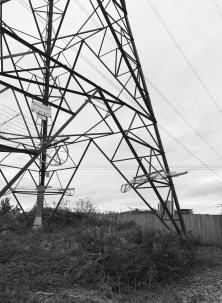 These edge lands – where ‘urban and rural negotiate their borders’ (Farley and Roberts, loc 183) – seem no more than ‘repositories for functions we prefer not to think about’ (Shoard, p.75). Gasometers, electricity sub-stations, security lit business parks, car pounds, sewage works, pylons, razor-tipped fencing and marshalling yards. They circle our towns and cities: uneasy crossing places haunted by ‘the neglected, the disposed of, and the repressed’ (Edensor, p.833). But, if we look carefully and without prejudice, we can recast these ‘unobserved parts of our share landscape as places of possibility, mystery, beauty’ (Farley and Roberts loc 198).
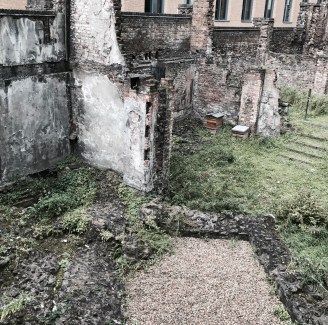 For look beyond the abandoned pallets and rusty JCBs, and vitality, energy and creativity emerge. What more could we expect in the marginal and liminal? Marion Shoard argues how edgelands are rich in plant and wildlife diversity: protected, forgotten and free of monoculture, pesticides and our compulsion to trim and prune. Similarly, Richard Mabey tells how rosebay willow herb and other ‘weed tenantry – ‘green and golden fennel and ragwort, coltsfoot, purple loosestrife’ – proliferated in the bombed out City warehouses and offices of the Blitz (Mabey, p.216). Glimpses of these ruderal fireweeds can still be found. By the
 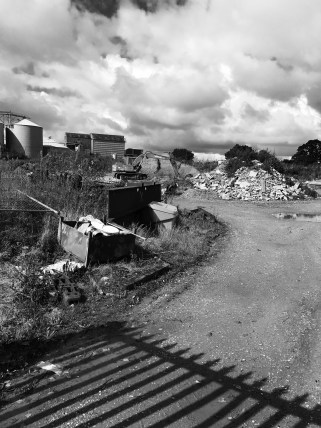 Even in one building though, we can locate edgelands. Think of lifts, basements, the maintenance workshop or, indeed, the humble photocopier room. Utilitarian in design and decor, it seldom provides a home to the artwork that decorates other walls or offers panoramic views of tower and sky. But, as wasteland attracts the detritus we casually discard there – fridges, tyres, thieved and ransacked slot machines – so here we find the box of Christmas decorations and a rag-tag of superseded office equipment. And, as we know from apocryphal tales of office parties, these humble backwaters generate their own transgressive stories.
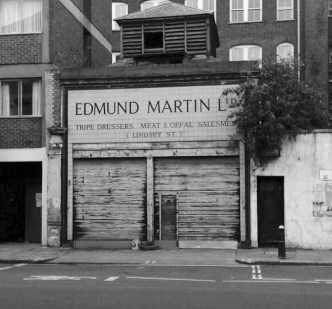 But these suggestive, liminal ruins are betwixt and between in other ways. Their journey of transition is constant as agents such as wind, rain, lichen, moss, birds and insects recast their identities and ‘transform the qualities of matter’ (DeSilvey and Edensor, p.477). This is not necessarily a cruel or pitiless destruction. Looking into a marble fountain,there is ‘intimacy in the contact’ between stone and water that ‘here produces a gleaming surface veined with unsuspected colours, here magnifies fossil or granular structure’ (Stokes, p.26). Ruination can be gentle, caressive, revelatory.
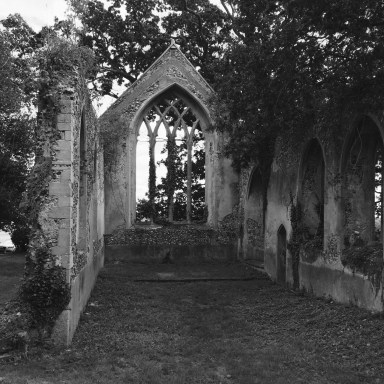 For this is a place where the visual is less privileged and where, unlike the usual tourist spaces, ‘the tactile, auditory and aromatic qualities of materiality’ are enhanced (Edensor, 2007, p.219). We are keen to the sound of the strimmer in the overgrown churchyard; the smell of the cut grass in the porch; the feel of the twig that bends underfoot as we navigate around fallen gravestones. This is Lefebvre’s perceived space – the ‘phenomenologically experienced spaces, that may be taken for granted through the habits of the body’ (Dale and Burrell, p.8). Note how we stoop past the shrub overhanging the south door – an automatic, reflex action.
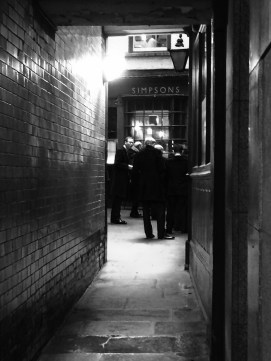 Liminality infects the scene in other ways. For Michael, the shooting of McCluskey and Solozzo represents a true rite of passage. It is liminal in the original anthropological sense – the shooting is a rite that accompanies transition: from outside the Corleone family to inside. Michael’s status, authority and identity are now in flux. Victor Turner observes how ritual subjects are suspended between the positions assigned by law, custom, convention and ceremony. Their previous identities are erased; their clothing indicative of a loss of status; their behaviour is passive, humble. Think of Michael, fleeing New York for temporary exile in Sicily. He dresses like a peasant; he succumbs to local custom; when courting Appolonia, he is Michael yet not Michael. Mary Douglas notes how the unclear or contradictory is regarded as unclean or ‘polluting’. Consequently, as neophytes are structurally ambiguous and therefore ritually polluting, they are commonly secluded from the realm of culturally defined and ordered states/statuses. Such transgression is symbolised by the shootings. To kill a police officer transgresses mafia code and so Michael needs to be physically and psychically excluded.
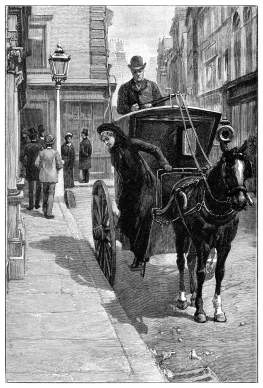 Our signalling is successful. A black London cab executes a perfect U-turn – a masterclass in precision and confidence – that attracts notice and does little to sate our desire for anonymity. We state our destination, open the door and step inside.
 Liminal Narratives