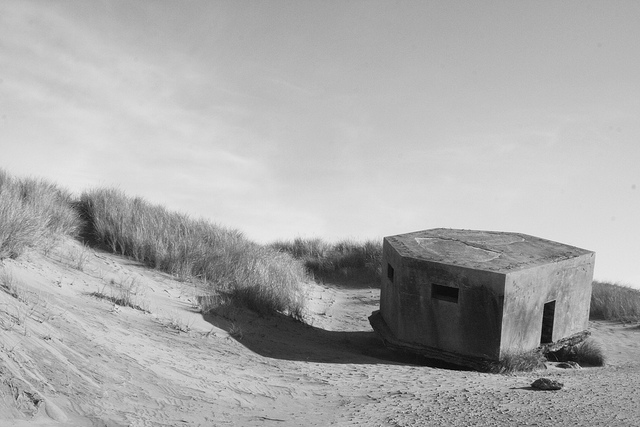
Let us return, one year on, to the beach. This is a ‘place of strong magic (Preston-Whyte, p.349); a trickster margin between land and sea, eternally shifting shape as the tides contest, claim and reclaim. Perhaps it is the ‘archetypal liminal landscape’ (Thomassen, p.21) – an alchemical strand poised on multiple ambiguities. For, as Meethan notes, it is rarely inhabited but often used; a space of play and a place of work; a scene of recreation yet one where hazard and peril grimly lurk; a haunt for the solitary and a magnet for the rowdy throng (Meethan, p.70).
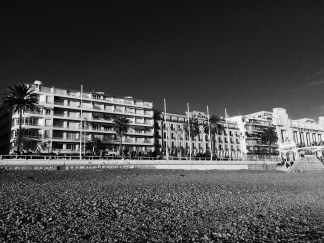 And, like all liminal spaces, the beach offers promises of transformation. In Rob Shields’ fascinating analysis of Brighton’s cultural positioning, he argues how the Prince Regent, later George IV, popularised the ‘reputedly restorative powers of sea-bathing’ (Shield, p.75). For the sick and valetudinarian, this was a pilgrimage covenanting physical renewal. And the reward for the devoted traveller was the ‘Cure’: a programme of prescribed sea-dippings (the rites of the liminal phase) officiated by ‘Dippers’. These ‘priests’ carefully (or forcefully) assisted their charges from the bathing machines: ‘mediaries between two worlds, civilised land and the undisciplined waves’ (Shields, p.84).
But where there is transformation, there is often transgression. For, in the liminal, in the ‘gap between ordered worlds almost anything may happen’. (Turner, p.13). As the Regency sea-water pilgrims gave way to the mass holidaymakers of the later 19th century, Shields identifies the emergence of Bakhtin’s carnivalesque: ‘a temporary suspension…of hierarchical rank…permitting no distance between those who came in contact with each other and liberating them from the norms of etiquette and decency imposed at other times.’ (Bakhtin, p.10). Here, betwixt work and home identities, the crowds of holidaymakers were free to imbibe, flirt and play. Liberated on the seashore, the adult became child – ‘expected to fool around, build sandcastles…and perform other “childlike acts”‘ (Baldacchino, quoted in Andrews, p.153).
This ‘aliveness’ of the carnivalesque, Shields argues, was reflected in the mass market success of the comic postcards. Here, authority was inverted as policemen, vicars and colonels became the victims of innuendo, embarrassment or lewd slips of the tongue. Yet there was a limit to this transgression: for ‘if they wink at such practices they also exert a kind of governing influence by playing so much on the breaking or bending of taboo’ (Shields, p.98).
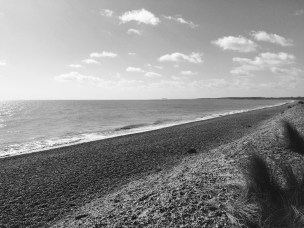 Remember though – the beach of summer becomes the beach of winter. And this brings more caliginous meanings. The borderlands and margins are ‘also places of anxiety replete with darker images of threat and danger.’ (Preston-Whyte, p.350). These ‘placeless places’ of No Man’s Land and crossroads – where the gibbet stands and the graves of suicides and witches lie – invite the liminal’s shadow (see Trubshaw, 1996). In M.R. James’ A Warning to the Curious and Oh, Whistle, and I’ll come to you, My Lad, the landscape of the beach reflects a ‘temporal instability’ where an artefact from the past has the power to exact a dreadful vengeance in the present.
wide-open sands with their wind-bent trees transport the viewer to a place out of time, where the omnipresent past is felt only in the ganglia or seen from the corner of the eye. (Easterbrook, quoted in Scovell, p.45)
And the beach’s multiple, symbolic meanings resonate in our worklives too. Historically, the seaside was the traditional locale of the works’ outing. Indeed, in my first job, an orders clerk in a Battersea warehouse, our reward for the fulfilment of a particularly onerous order was a day trip – on a coach, or charabanc if you romantically prefer – to, inevitably, Brighton. Here, our liminal day unfolded. Our dress reflected our holiday status and suggested no boundary between packer and managing director. We were liberated from the ‘normative practices and performance codes of mundane life’ (Shields, p.84) and true to liminal form, we embraced the carnivalesque: sun, drink and a somewhat frank exchange of views with senior management on the increasingly hungover return leg along the South Circular.
But these are more sophisticated times. Yet perhaps the ubiquitous awaydays, offsites, retreats and conferences we enjoy (or endure) are the beach’s close, metaphorical cousins. Rina Arya, in an investigation of the awayday involving a solicitor’s firm and a retail chain, identified the ‘opportunities it provides to have fun – to socialise, dress down and to enjoy treats courtesy of the employer’ (Arya, p.24). Indeed, as one of the interviewees commented: “it felt like a mini break”. Or, a day trip to Brighton, in all but name. With the boundaries loosened between work and family life, some experienced the away day as an opportunity to define their identity, to reflect, to ‘take stock of things’ and, on returning to the workplace, ‘felt more uplifted and fulfilled’ (Arya, p.27). Such spiritual and psychological revival mirrors the physical rejuvenation of our ancestors seeking the ‘Cure’. And perhaps we too have our contemporary ‘dippers’. Although here we call them facilitators or trainers guiding their initiates through the rites of workshop and breakout session and bearing the sacramental vessels of post-its, flip charts and PowerPoint.
We can also distinguish elements of the carnivalesque as hierarchies are relaxed and the lines between roles, functions and structures blur and coalesce. Elsewhere, transgression may come to the fore. In a study of hotels as liminal sites, Pritchard and Morgan observe how conferences and conventions ‘create opportunities for illicit sexual encounters’. They see this as a consequence of the very liminality of hotels – ‘as crossing points into the unknown, as places of transition and anonymity, hidden from familiar scrutiny’ (Pritchard and Morgan, p.769).
And, for some, the awayday will always be the ‘placeless place’: a source of anxiety or frustration where there is pressure to ‘act a part, to conform, to perform even’ (Arya, p.30). Here identity is constrained not liberated and the guiding hand of management suspected and distrusted.
So, as you plan your next awayday, reflect on the multiple meanings and symbolic resonances that your carefully scheduled event subtly invokes. Remember the dippers, the blushing vicars in McGill’s comic postcards and M.R. James’ vengeful revenants. Which ones do you wish to invite? Whose stories do you wish to hear? And, as always, be careful in your choice.
Andrews, H. (2012) ‘Another place or just another space? Liminality and Crosby Beach’, in Andrews, H. and Roberts, L. (eds.) Liminal landscapes: travel, experience and spaces in-between. Routledge.
Arya, R. (2011) ‘Transitional spaces: the phenomenology of the awayday’, Tamara Journal for Critical Organization Inquiry, 9(3/4), pp. 23–33.
Bakhtin, M.M. (1984), Rabelais and his world. Indiana University Press
Meethan, K. (2012) ‘Walking the edges: towards a visual ethnography of beachscapes’, in Andrews, H. and Roberts, L. (eds.) Liminal landscapes: travel, experience and spaces in-between. Routledge.
Preston-Whyte, R. (2004) ‘The beach as a liminal space’, in Lew, A, Hall, C.M. and Williams, A (eds.) The Blackwell’s tourism companion. Blackwell.
Pritchard, A. and Morgan, N. (2006) ‘Hotel Babylon? Exploring hotels as liminal sites of transition and transgression’, Tourism Management, 27(5), pp. 762–772.
Scovell, A. (2017), Folk horror: hours dreadful and things strange. Auteur Publishing.
Shields, R. (1991), Places on the margin: alternative geographies of modernity. Routledge.
Thomassen, B. (2012) ‘Revisiting liminality: the danger of empty space’, in Andrews, H. and Roberts, L. (eds.) Liminal landscapes: travel, experience and spaces in-between. Routledge.
Trubshaw, B. (1996). Why Christopher Robin wouldn’t walk in the cracks: an introduction to the liminality of place and space. http://www.indigogroup.co.uk/edge/liminal.htm (accused 17 February, 2018)
Turner, V. (1974), Dramas, fields and metaphors: symbolic action in human society. Cornell University Press.
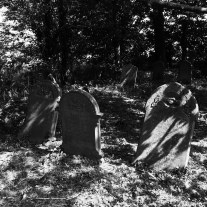 Strolling along the well-tended gravel paths or clambering over crumbling, bindweed ensnared masonry, we can easily slip between multiple worlds. In their considered and sensitive study of roadside memorials, Clark and Franzmann note how these sites challenge ideas about what is public/private or secular/sacred space: they blur the ‘somewhere that is nowhere in particular rather than a special place, and something that is passed by rather than permanently set aside as a place of pilgrimage’ (p.586). As we stroll or clamber, are we visitor, pilgrim, the transitory or the purposeful?
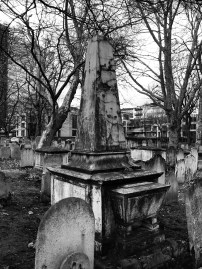 For Foucault, the cemetery is an example of a heterotopia: sites which ‘mirror and at the same time distort, unsettle or invert other spaces’ (Johnson, 2013, p.790-791). It is a place ‘unlike other cultural spaces’ (Foucault, p.4) yet which is connected with all sites as ‘each individual each family has relatives in the cemetery’. As Johnson notes, cemeteries incorporate many of the characteristics of heterotopias that Foucault identified. They are ‘privileged or sacred’ sites reserved for a critical rite of passage; they ‘contain multiple meanings; and they are both utterly mundane and extraordinary’ (Johnson, 2013, p.799). Intriguingly, they also begin ‘to function at full capacity when men arrive at a sort of absolute break with their traditional time’ (Foucault, p.6). The graveyard elides ‘slices of time’ since ‘the dead are outside of time, relegated to what Foucault terms a quasi éternité‘ (Gandy, p.733).
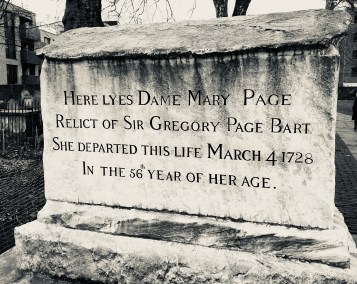 So before we leave our graveyard, let us take a final look around. We may see toys, flowers, photographs, candles and other personal artefacts placed carefully around the graves. They reassure the absent (and, of course, those that remain) and ‘link the tangible present to an intangible past (and future) of imaginary times and spaces’ (Clements, p.476). They also invite stories; and, with the epitaphs and inscriptions, offer clues and plot-lines that we craft into narratives breathing life into those that lie beneath us.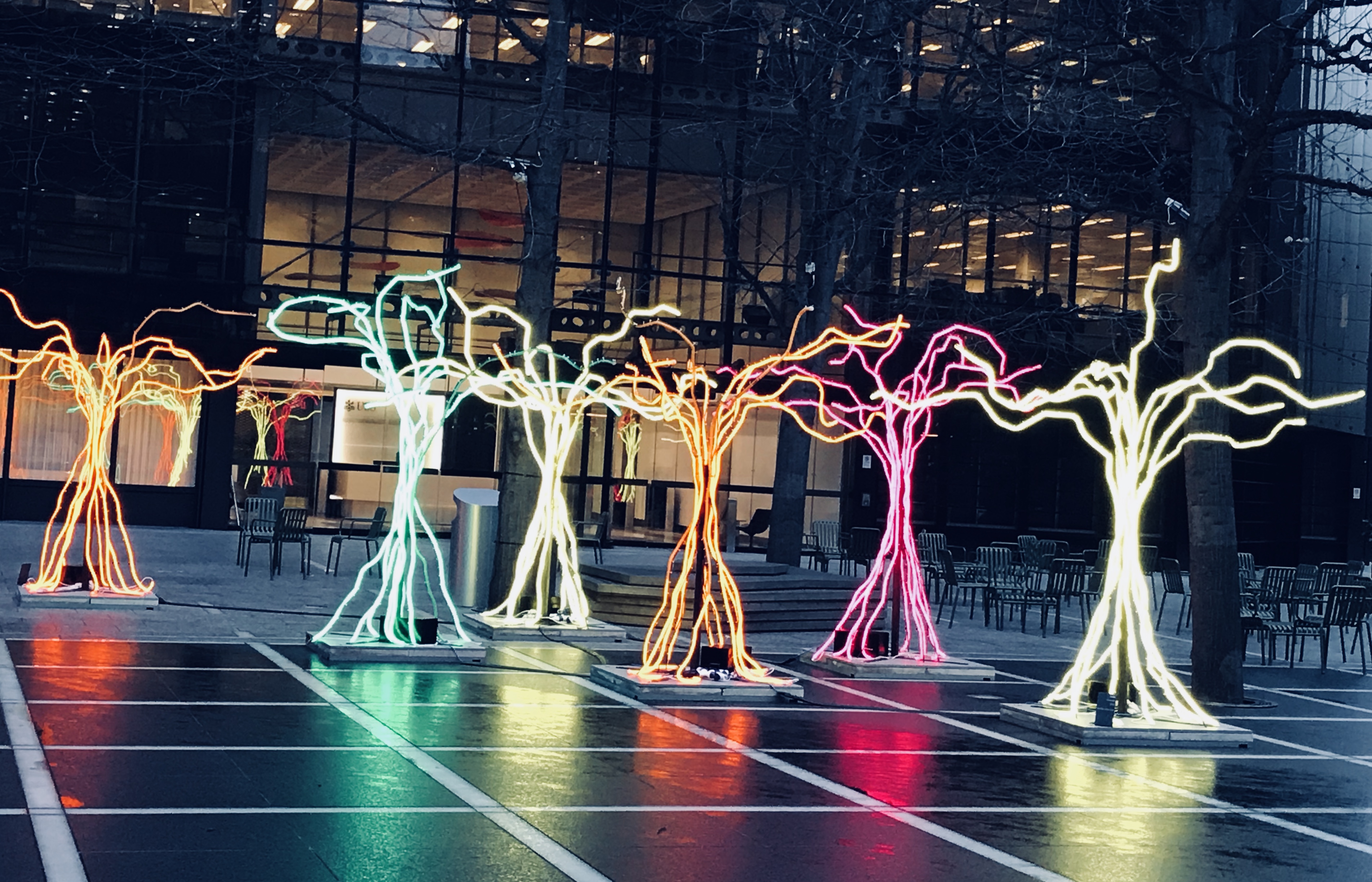

 Stepping between floors, we are, spatially, betwixt and between: poised between one zone of experience and another. Or, as AA Milne (and, yes, the Muppets) phrased it: ‘It isn’t really anywhere! It’s somewhere else instead!’ In a recent Radio 4 Thought for the Day broadcast, Rabbi Dr Naftali Brawer describes the painting by the Baroque artist Jusepe de Ribera called Jacob’s Dream. The sleeping Jacob dreams of a ladder that climbs to heavens with angels ascending and descending. Brawer draws attention to how Ribera depicts Jacob’s face: it ‘exquisitely captures the betwixt and between of liminality, reflecting Jacob’s suspension between two realities; the terrestrial and the celestial.’
 The staircase serves as a vertical
 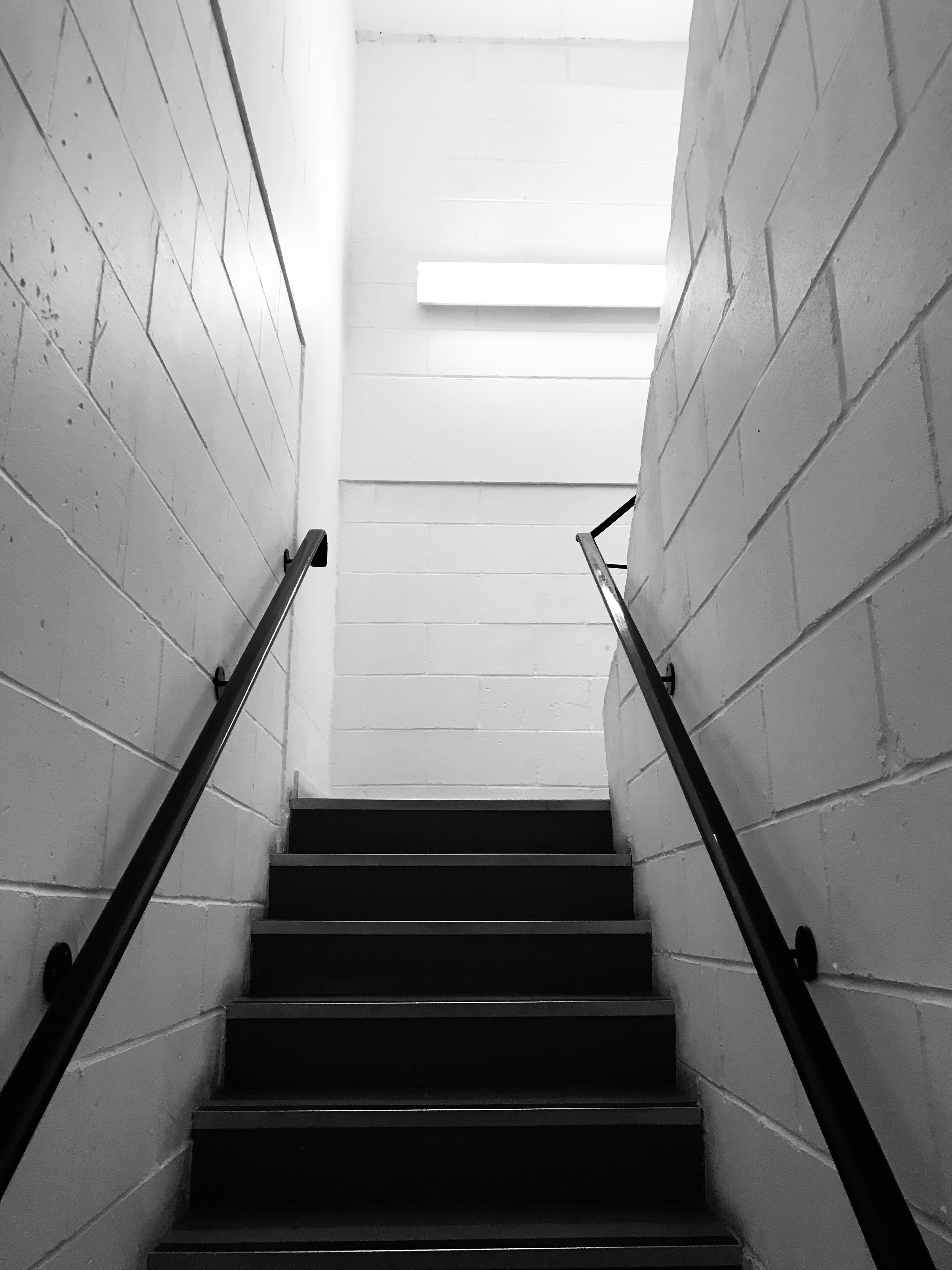 In a perceptive analysis of white spaces, Connelan notes the visceral reaction of one interviewee to the staircase in an art school: it ‘gives me the creeps, it reminds me of [the detention centre the person was incarcerated in] (Connelan, p.1543). There is a ‘brutality inscribed into the identity-less space’. The blank institutional whiteness of steps and stairs create a stark backdrop against which it is easy to be seen. You are isolated, silhouetted, the object of the carceral gaze. Here, white materialises power and exerts control. This creates not Foucault’s mobile panopticon but a ‘ubiquitous panopticon’ in which ‘watchfulness is everywhere and nowhere’ (Connelan, p.1545). The staircase encourages us both to linger and to escape.
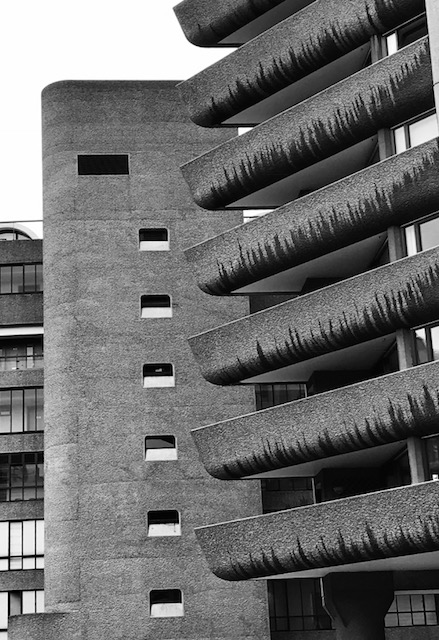 The Barbican in London is a source of solace. Walking the grey, water-stained ramparts, I feel protected by its coarse solidity. The hard, excoriating drag of bush-hammered aggregate reassures rather than pains. This is a place – fittingly given its name – of defence, retreat and enclosure. In my more oneiric moments, I imagine a dystopian city of hand to hand fighting – a Stalingrad for a future age – with the Barbican providing the last refuge for defiance and resistance. With a morbid eye, I see the walkways and towers pitted by shellfire revealing the twisted steel rods within.
 Several of these
  Liminal Narratives