It goes something like this.
You’re driving. It’s night – let’s say late October. A country road, moon bleached behind threadbare clouds.
You pass the crossroads and see a figure in the rear-view mirror. Strange. You could swear it wasn’t there before.
And then you see the outstretched hand; the extended thumb. You take pity for tonight, of all nights, is not a time to be hitch-hiking alone. You come to a halt and open the passenger door. But the figure – a girl, slight, her face shadowed by the hood of her coat – slips into the back of the car. She whispers the name of the next village along the road before shrinking into silence. You drive on.
* * * * * * * * * *
For Marc Augé, the autoroute is a non-place. It ‘avoids, for functional reasons, all the principal places to which it takes us’ (Auge, p.79). The only connectors are the road-signs alerting the driver to nearby sites of interest. The symbols and ideograms signify vineyards, hill-top villages, lakes and canyons – yet our only pleasure is the mere knowledge of their proximity rather than the experience itself. As Malcolm Andrews observes, they are a ‘constant reminder of what we might be missing by choosing to travel in this way’ (Andrews, p.63). On the motorway, we are there but never there. The road is always skirting, avoiding, bypassing. A liminal track forever on the margins.
 And there are margins to the margins. The hard-shoulder, the lay-by, the aire. Yet are these liminal spaces entirely what they seem? In a quest to recreate both Robinson Crusoe and JG Ballard’s Concrete Island, Les Roberts marooned himself on a motorway traffic island on the M53 – a ‘liminal space of oblivion par excellence’ in which ‘memory afforded ‘little in the way of traction’ (Roberts, p.572). By exploring the ‘rhythms and cadences’ of this shielded patch of scrub and woodland, he sought the ‘negation of the negation of place’ (p.570) and to reinvent the liminal as ‘a launch pad of the imagination’ (Roberts, p.596).
This revelatory reading of the motorway is echoed by Tim Edensor who, countering Augé’s ‘dystopian assumptions’, finds it ‘rich in mundane comfort and sensation, replete with small pleasures and diverting incidents and thoughts’ (Edensor, p.151). This is an enchanted place of myth and sly magic where the tarmac peels to release ‘memories of other journeys, those of the past and those still to be completed’ (Edensor, p.164). For the landmarks we pass are invested with our own symbolic resonances that shimmer with memory and association. I recall the excitement when, as a child from the East Anglian flatlands, we passed the first cooling towers on the long journey north to Scotland – for this was a sign of difference, an index of alterity. Transport café, Little Chef (where the pancake, vanilla ice cream and maple syrup were richer in association than any Proustian madeleine) and the roadside gibbet at Caxton. These were sanctuaries of the imagination imbuing the unknown with familiarity. And with each journey, the memories accrete as the ‘elsewheres, pasts and futures’ enfold and elide (Edensor, p.153).
The negation of the negation even embraces the service areas. Simon Armitage’s poem Gymnasium concludes a list of the emblems of loneliness – the life guard ‘two years without a shout’, ‘Christmas for one’, ‘shower blocks and spent soap’ – with ‘The drive. The motorway service station/as a destination in its own right’.
 But even this bland sign of sterile mundanity reveals a past of nuance and faded enchantment. When first built, they were ‘glamorous, semi-touristic’ places’ (Moran, p.108) with bridge restaurants where diners, treated to silver service, liveried waiters and seven course meals, could watch the passing traffic. Such was their exotic allure, eager visitors could buy postcards to enthral envious friends. These, and similar postcards from the 1960s and 1970s depicting shopping precincts, caravan parks and holiday camps, are collected in Martin Parr’s Boring Postcards. With their ‘overprocessed colour, clumsy tinting and cheap lithography’ (Moran, p.124), they appear eerie, unnatural. Our disorientation is enhanced by a tendency to picture these spaces without cars or people ‘so that they seem almost like ancient ruins, opened up to questions of memory and history’ (Moran, p.125). This cadence of dissolution is echoed by Martin Chell who senses the ‘bittersweet nostalgia of a future ruin’ in the now abandoned Forton Tower. As it presides ‘like a doomed sentinel over a sclerotic M6’ (Chell, p.13), we hauntologically glimpse a future that never was.
And, like all liminal spaces, this is a place of ludic transgression. The early service stations suffered from theft and vandalism with motorists stealing cutlery, lavatory seats, toilet-roll holders, mirrors and coat-hooks (Moran, p.109). Meanwhile night at the service station exposes ‘another world…beneath the sheen’ (Lawrence, p.85). And this world is one where ‘disorder beckons’: a site of crime, sex and violence.
Our expectations are subverted in other ways too. For Augé, it is ‘anthropological space’ – the antithesis to the non-place – where ‘a story can be made out’ (Merriman, p.148). But the liminal has other ideas. When commemorating the 600th anniversary of the death of Geoffrey Chaucer, BBC Radio decided that an M1 service area would serve as the ideal meeting place for the travellers to recite their tales. These are ‘in between places, unconnected in many ways to their surroundings’ (Quoted in Merriman, p.160) and the in-between is always a storied space. It was in service stations that motor-cycle groups congregated to ‘share stories’ and bands, criss-crossing the country in battered Transits met to ‘exchange news and knowledge’ (Lawrence, p.86). Intriguingly, Liminal Residency – ‘an alternative writers’ retreat which takes place in a range of neglected and unusual spaces’ – held its first event at Peterborough Services Area. For ‘there is every chance that you have been here without ever even knowing it’.
But roads, motorways and service stations are not just sites for storytelling but the very subject itself. Listen carefully and you will hear these stories told by ‘commercial travellers and sales personnel, lorry drivers, maintenance staff, traffic police, motorway service workers, and coach drivers’: motoring experiences exchanged as ‘gossip and tale-telling’ (Edensor, p.164). And one mythic thread that runs through this folklore of the road is that of the hitch-hiker. The ‘unpredictable…potentially dangerous…often uncanny other…who haunts the verges and slip roads’ (Edensor, p.164).
So let us end at the beginning.
* * * * * * * * * * *
You drive for several miles, glancing at your silent companion huddled in the back. The car is cold and you turn up the heating but it seems to have little effect.
As you drive into the village, you ask whether the destination is nearby. There is no response, so you repeat the question. Again, there is silence so you glance in the mirror and see…nothing.
Of course, the narrative – familiar yet ever mutable in its telling – demands you stop the car and search with desperation, puzzlement, disbelief. The story ends, as it always has, with you alone on star-starved lane, as the wind scatters the leaves in the nearby churchyard.
And the diamonds on my windshield
And these tears from heaven
Well I’m pulling into town on the interstate
I got me a steel train in the rain
And the wind bites my cheek through the wing
Late nights and freeway flying
Always makes me sing
It always makes me sing.
Tom Waits, ‘Diamonds on My Windshield’
Andrews, M. (2012) ‘The autoroute and the picturesque’, Corkish, A. (ed.) In the company of ghosts: the poetics of the motorway. erbacce-press.
Armitage, S. (2010) ‘Gymnasium’, in The motorway service station as a destination in its own right. Smith/Doorstep Books.
Augé, M. (2008), Non-places: an introduction to supermodernity. Verso
Chell, E. (2012) ‘Foreward’, in Corkish, A. (ed.) In the company of ghosts: the poetics of the motorway. erbacce-press.
Edensor, T. (2003) ‘Defamiliarizing the mundane roadscape’, Space and Culture, 6(2), pp.
Lawrence, D. (2012) ‘When A to B is not the point…’, in Corkish, A. (ed.) In the company of ghosts: the poetics of the motorway. erbacce-press.
Moran, J. (2005), Reading the everyday. Routledge
Merriman, P. (2004) ‘Driving places’, Theory, Culture & Society, 21(4–5), pp. 145–167.
Parr, M. (1999), Boring postcards. Phaidon.
Roberts, L. (2015) ‘The rhythm of non-places: marooning the embodied self in depthless space’, Humanities, 4(4), pp.569-599.
The Liminal Residency. (2018) ‘Peterborough Services Area’, 23 February 2018. Available at: https://www.liminalresidency.co.uk/portfolio/peterborough-service-area/.
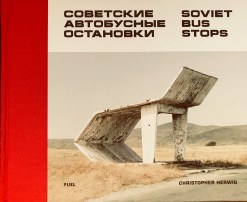 This elision of time, a never realised past imagining of the future in the present, marks their liminality – as does their gentle ruination. For
 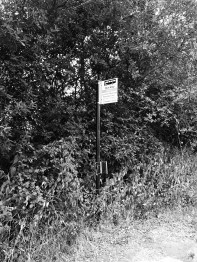 This communality suggests another way to view the bus stop. In a study of chiropody clinics, Karen Pettigrew introduces the concept of the ‘information ground: an ‘environment temporarily created by the behaviour of people who have come together to perform a given task, but from which emerges a social atmosphere that fosters the spontaneous and serendipitous sharing of information’ (Pettigrew, p.811). In later research (writing as Fisher), she identifies the ‘ambient role of place’ and the ‘specific effects of social settings on information flow’. These include places of worships, restaurants, cafes and ‘hostage phenomena such as self-service laundries, stores queues and, yes, bus stops (Fisher, Landry and Naumer, 2007).
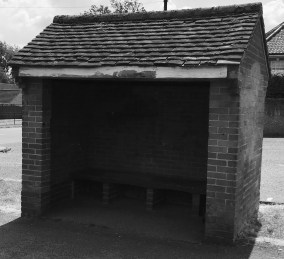 And for those in rural England, we need not look as far as the former Soviet Republics to appreciate such spatial affordances. For the village bus stop is not solely reserved for those desiring to travel. As dusk falls, this becomes the haunt of more youthful phantasms. The detritus of cans, broken cigarette and runic scribblings on the brick walls marks their presence. For this is also a youth club, congregation point and playground. A ‘third place’ for the young and spatially dispossessed with its perfectly imbricated blend of privacy, propinquity and social designation. It also conceals a sly subversion of power. Applying a Lefebvrian lens, the conceived space of the architect and planners – which designates the actions and behaviours to be carried out there – is resisted and contested. Our phantasms have appropriated it for other uses: their routines and behaviours (perceived space) belie the sanctioned use (Lefebvre, 1974/1991).
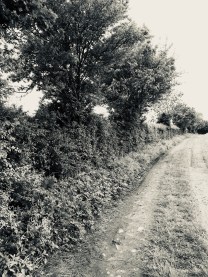 And ambiguities multiply and enfold. For some, the hedge is a space of nest and burrow. A refuge from predator and storm where it is safe to roost and sleep. Yet this is also a place of danger – for concealment carries both blessing and curse. The eyes that spark in the undergrowth; the rank tang of fox or weasel. In the slanting dusk, the silhouettes of blackthorn and dog-rose invite the unknown. They are ‘uncanny artefacts’ that trouble and disturb (Kaczmarczyk, p.55). Perhaps all hedgerows intimate the zone rouge: this now fertile no-man’s land which bears its stain – and its dark bounty of bone and bullet – through the decades. For every Prince that finds his Sleeping Beauty, lie many others pierced and bleeding on the thorns.
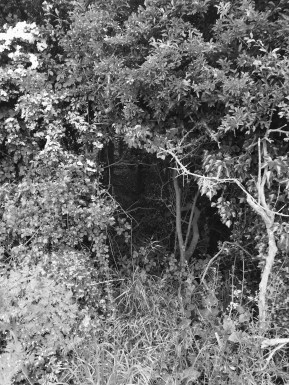 Elsewhere, the devastation has been unleashed. According to Dale and Burrell, seven miles of internal walls in the UK Treasury were removed, ‘literally dismantling the ‘corridors of power’’ (Dale and Burrell, 2010). To justify this destruction, those arguments of productivity and enhanced yield emerge from their 1950’s winding sheet. But here the grain and seed so eagerly sought are those of ‘interactive, complex, open-ended teamwork’ and the diminution of ‘hierarchies or status’ (Hirst and Humphreys, p.1506).
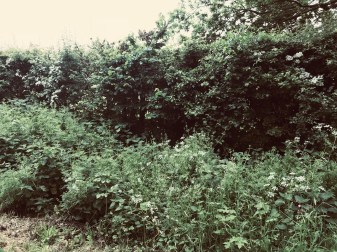 So maybe we should campaign for the return of our metaphoric organisational hedges. Allen identified ‘washrooms, copying machines, coffeepots, cafeterias’ as ‘interaction-promoting facilities’ that draw people to them increasing the occurrence of chance encounters and unintended communication (Allen, p.248). And these ‘hedgerow rendezvous’ have value: they are the ‘prime vehicle for transmitting ideas, concepts, and other information necessary for ensuring effective work performance’ (Allen, p.269).
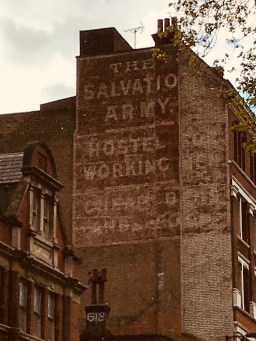 These signs – material and metaphoric – ‘both reveal and hide their identity’ (Shep, p.209). They exist in plain view yet their meaning has to be negotiated via erosion, neglect and decay. Like Baudelaire’s flaneur detective, we need to decipher and deduce (Benjamin, p.37). For these signs exist at the liminal convergence of topography, typography and temporality (Shep, p.210). They inhabit multiple margins; permeate many thresholds. And this very materiality is, of course, liminal. As scouring wind, rain and pollution ‘transform the qualities of matter’ (DeSilvey and Edensor, p.477), their journey of transition is constant: as ‘palimpsests, they register change over time’ (Shep, p.209).
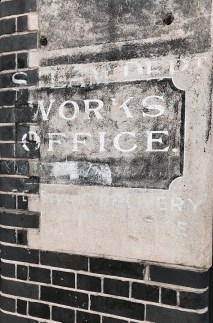 And there is something both poignant and heroic about these ghost signs. Even though their purpose – their signified is absent – they continue to signify to an intended audience that, in all probability, are ghosts now too. It brings to mind an abandoned turntable endlessly playing the same track to a long-departed listener. For these ‘names and slogans…were not meant for our contemporary eyes’ (Roberts and Marshall, p.3). And this, maybe, is what captures our gaze from train and street. This prickling of curiosity; a glimpse of something we can’t immediately comprehend yet sense, in some way, to be important. The sudden sound of static that interrupts our car radio on a moonless country road: significant but unknowable.
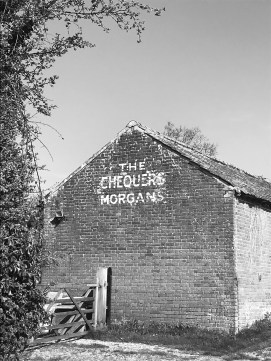 Such ghosts ‘haunt the present in such a way as to suddenly animate the past’ (Edensor, p.159). As I walk up the lane towards the sign of the former Chequers pub, I am conscious that my steps echo those of villagers who, for many years, would have tramped the same route after a day working the fields. And their embodied practices and daily rituals are now re-enacted by those now drawn by the sign. The past is reinvented and reimagined with each step. As Edensor notes, we ‘perform the past by putting our bodies into its flow’ and, in so doing, ‘it ceases to be pure memory; it is lived in the present’ (Edensor, pp. 150-151). And these experiences, these micro-narratives we co-create through such embodied empathy, although fragmentary and seemingly incoherent, ‘offer opportunities for constructing alternative versions of the past, and for recouping untold and marginalized stories’ (DeSilvey and Edensor, p.471). The ‘enigmatic traces’ of the Chequers pub invites me to ‘fill in the blanks’ (Edensor, p.162). My imagination – via stories – aims to ‘impose a formal coherence on what is otherwise a flowing soup’ (Weick, p.128).
 But then, this should not surprise us. For the crossroads is a place of contradictions. A liminal space caught between borders and possibilities. It is a ‘real place between imaginary places – points of departure and arrival’ (Komunyakaa, p.5). We stand poised between where we have been and where we might, in the future, find ourselves. This is the ‘intersection of the timeless moment’ (Eliot, p.42). Opportunity, danger, enchantment, despair, salvation and damnation insinuate themselves, like a twilight mist, around our lonely fingerpost.
 The ambiguity of the crossroads is also seen in the tradition of burying of suicides. Halliday notes that although the law in England stipulated that a suicide should be buried in the King’s highway, the chosen site was often a crossroad by a parish boundary (Halliday, p.82). I frequently pass one such site. In 1785, Richard Knobbs, a brickmaker in the Norfolk village of Hempnall, was suspected of murdering his son and hanged himself from a tree. The junction where he is buried is still known as Nobb’s Corner. Halliday argues that such interment acted as a deterrent. Excluded from the community of a churchyard, burial in a ‘remote, anonymous grave without a funeral was a casting-out; the person no longer belonged to society’ (Halliday p.82). Yet, maybe, such a place provided comfort too: the topographical cross bestowing some remnant of sanctity on the lost and, in every way, marginalised.
 Liminal Narratives