Time

img_2815

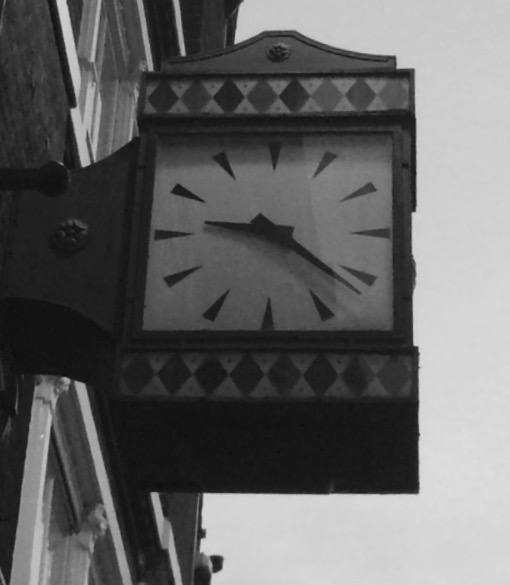
My innovation friend, Tom Lilley, perceptively observed that ‘many of the liminal zones I encounter on the job are actually temporal – the present and future rubbing up against the weight of the past’.   Tom noted the organisational archives/trophy cabinets lined with artefacts and photos that embody the company’s history.  At one extreme, this might be a plane suspended from a ceiling; or a full-sized running track.   I relished the observation and it set me thinking.  Such displays create an uncertain temporal zone that blends past and present – sometimes in a complementary and mutually illuminating way; sometimes with a jarring discordance worthy of the most free of free jazz improvisations.

David Boje, with reference to Walmart, identifies the dilemma with the strategic journey narrative: how ‘to appear to be the same over time, and to appear to be different, reflecting shifts in innovation and the environment’ (Boje, 2008: 10).  The relationship between past and present is uneasy and infected with suspicion.  It is also rarely stable.

I recall visiting a financial services company HQ with a striking museum in its foyer: information boards, old signs, uniforms and photographs that charted its 200 year plus history.  To an employee it symbolised an epic narrative: adversity countered, challenges surmounted, growth assured.  To a business partner or customer, it symbolised reassurance, solidity, longevity: your money, your relationship is safe with us.

I was intrigued to learn that several years previously when the company underwent a substantial rebrand, the incoming CEO had removed the display.  The decision reflected the neat ambiguity in Tom’s phrase – the ‘weight of the past’.  Rather than representing comforting solidity, here weight signified a burden – a rock roughly bound to the chest dragging you to the bottom of the competitive lake.

Perhaps it also shows how organisations try to suppress the narratives that fail to fit with the current conception of self.  The rebrand – even encompassing a new name and logo – was designed to exorcise these stories from the past.  But as ghosts may often resist exorcism, so do stories.  They may be driven to the shadows yet they show remarkable resilience and fortitude.  Locally, the company is still referred to by its old name – the company’s story is also one of the region and so even more difficult to erase.

So why the decision to reinstate the display? You might point to a fresh CEO with a different view of the past.  Or, you might assume that several years after the rebrand, the old stories no longer had the power to influence; they had been subsumed by new stories of modernity and the future.  Or, perhaps, it was accepted that the shadows could never be dispelled nor the stories fully exorcised and so it was only fit they should be allowed back in over the threshold.

Someone else talking about time, once observed

‘Far away, across the field
The tolling of the iron bell
Calls the faithful to their knees
To hear the softly spoken magic spell’

So maybe this was one softly spoken magic spell that could never be broken.

References

Boje, D. (2008), Storytelling Organizations. London: Sage

shoreline

img_1962

Story master Shawn Callahan was kind enough to comment on my first post and suggest an additional metaphor for receptions.  Whereas I had riffed on the concept of a border crossing, Shawn wisely emphasised the idea of a shoreline.  And it’s a metaphor I like.  For receptions are places of ebb and flow, subject to a diurnal low and high tide as employees and visitors arrive and depart.   And just as the tides leave a detritus of seaweed, driftwood and, in my native Norfolk, rucksacks of carefully wrapped  cocaine, so the human flow leaves its own traces: a temporary imprint on a leather seat; a corporate magazine left open at a nonchalantly scanned page; a half drunk cup of earl grey.

Similarly, as deserted shorelines exude a certain melancholy, so receptions, in those late evenings or weekends, possess a lonely, even uncanny, mood.  The lighting subdued, the aggregate floors and walls prone to echoes, the security guard, a lonely sentinel peering through the plate glass windows to the wild seas beyond.

These shorelines – liminal, deserted – are places for story.  Each attracts the other.  M.R James, probably our greater writer of the uncanny, knew it well.  In Oh, Whistle, and I’ll come to You, My Lad, the antiquarian Professor Parker dreams of a terrified, exhausted man pursued by a ‘figure in pale, fluttering draperies, ill-defined’ along a ‘stretch of shore – shingle edged by sand, and intersected at short intervals with black groynes running down to the water’.   As a result of his horrifying experience at the climax of the story, Parker is arguably a changed man – his ‘views on certain points are less clear cut than they used to be’.  Although, such enlightenment comes at a price: ‘the spectacle of a scarecrow in a field on a winter afternoon has cost him more than one sleepless night’.

As the story shows, the liminal can be a place of discomfort, of knowledge gained and innocence lost: a place of ambiguous transformation.  So, next time you find yourself in a deserted reception, not only may the artefacts around you carry a greater potency (as there is less to distract you from the stories they carry), but you may find it prudent not to look behind you. Those footsteps you hear are getting closer, and closer still…

coffee

img_1841

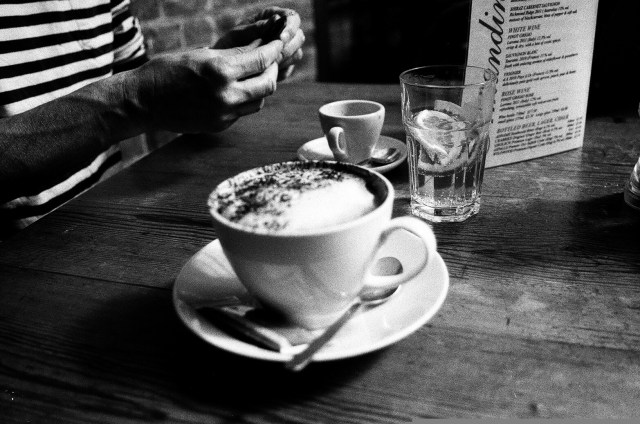
It’s time to return to an earlier post.  A KM colleague and friend gently steered me towards this excellent Radio 4 and World Service broadcast.  In 1687, in Tower Street, London a coffee shop opened.  Here the patrons could enjoy ‘fires, tea, coffee and sherbet’…and gossip.  And, boy, did these patrons like to talk about ships and their comings and goings: the tides, the ports, the captains, the cargoes.  Eventually, the proprietor, Edward Lloyd, started a newsletter – Lloyd’s List – to capture the knowledge circulating within Lloyds’s Coffee House and so an industry was born.

You could argue that Lloyd’s List was a classic example of how to take unstructured knowledge – the swirl of conversation that embraced facts, rumour, speculation and intuition – and make it explicit via a physical artefact.  But did those conversations then shrivel and wither in the face of this written competition?  I would wager (which was an integral activity within the 17th century coffee house) they intensified as the List was discussed, dissected and deconstructed.  I would also wager that stories were a vibrant thread through those conversations.  And those stories were rich with meaning  impossible to capture  in a simple journal.  It wasn’t just the words; it was also the performance: the gestures, the intonations, maybe the ushering into a quiet booth before the story was told, that would have helped convey the experience.  As Walter Benjamin, argued, experience is the “source from which all storytellers have drawn”.

There is something else about Lloyd’s Coffee House which interests me.  It was a space that combined the social (the partaking of tea, coffee and sherbet) with business.  This ambiguous space was re-visited by that most incisive of KM commentators, Chris Collison, in his mischievous post about the KM powers of coffee. He gives eight reasons for why coffee is KM’s most effective tool.  I would add a ninth.  It unlocks stories.  Just as the patrons of Lloyd’s Coffee House found the environment and the caffeine a stimulus to stories, so I have noticed something similar in our 21st century cafés.

Rather than take clients to a formal meeting room, I prefer to take them to our work café.  It immediately injects a curious dynamic to our conversation.  We are moved out of the purely business and formal to a more ambiguous environment.  And here the conversation becomes looser.  The influence of the social context encourages revelation and confidences.  Although, anecdotal, I also hear more stories as we sip our espressos, macchiatos or green teas, than I wager I would in the polished wood and hard-backed chairs of our ‘proper’ meeting spaces.  And that way, knowledge is conveyed.  Rich knowledge not just about the topic under discussion but about the personality, the motivations, the values, the beliefs, the fears, the frustrations, the ambitions of my fellow imbiber.

As Dr Feelgood, purveyor of so many truths once wisely observed, “Java Blue, when the coffee’s got me”.

Insurance

A good friend and colleague reminded me earlier in the week about a blog I had written nearly nine years ago about Lloyd’s of London.  You may know the building: a Richard Rogers masterpiece which really does look like nothing else in the city and which famously displays its insides on the outside, so to speak. At the time, I had been struck how a strikingly modern exterior conceals a world that is profoundly Dickensian. The Lutine bell guarded by an assistant in his Victorian red jacket and top hat; a cabinet of Nelson memorabilia; a huge log recording ship losses in perfect ink calligraphy. And, around this museum-like core, a series of huge trading floors full of underwriters’ booths where brokers queued to place their risks face to face (or rather eyeball to nose as brokers sat two inches below underwriters to ensure the underwriters’ eye level was above that of the broker). I saw people carrying unfeasibly large bundles of paper (indeed, the more astute wheeled suitcases of the stuff) and risks were recorded not on a laptop or tablet but written on a chit of paper.

I had not realised it then, but this was a peculiarly liminal world.  An unsettling locale where the starkly modern mixed with the quaintly traditional.  And, so, surely a place of stories as well as transactions?  For here, what lay at the heart of business, was a reliance on face to face contact as the primary way of doing business. Some commentators have used the analogy of the bazaar to illuminate the workings of knowledge management and it was not a huge leap of the imagination to see the Lloyds trading floor as a more starchy, peculiarly British version of a Moroccan souk. Business was transacted via, and underpinned by, the knowledge and trust that evolves via a network of direct relationships enclosed in a defined physical space. It was a true market.

At the time, it was an exciting reminder that  KM  can be a messy, chaotic thing that happens when you put people together in one place and they talk, and they get to know each other and the knowledge they learn in the process is filtered by and developed in the context of what they feel about that person and the extent to which they trust them. Think of the way lawyers are trained: a trainee lawyer, like a medieval apprentice, “sits” with a principal which means they don’t just learn technical legal knowledge but a whole raft of other essential expertise from negotiation and client management to delegation and business development. And a fair amount may occur through pure osmosis rather than conscious tuition: the physical proximity of sharing an office together.  It may also involve stories – the unconscious recounting of examples, analogous situations – some mundane, some heroic, some minatory.

So maybe the lesson is for us to maximise opportunities for face-to-face contact, to facilitate the “osmotic moment”; but not in a mechanical prescribed way but by making it a natural part of working together and doing business.  And who knows what stories may emerge.

And, talking of stories, Lloyd’s, of course, started over 300 years ago as a coffee shop.  So maybe my next post will be about coffee; maybe…